
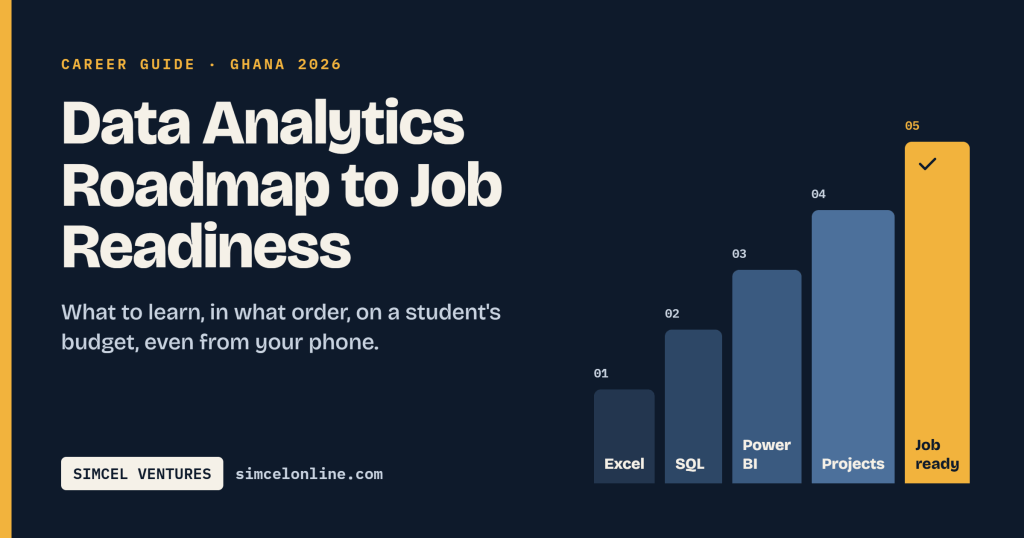
Many young Ghanaians have heard that data analytics pays well. They have watched a few YouTube videos and then got stuck asking, “What do I learn first, and how do I know when I’m ready to apply?” Maybe you’re a student in Ho, a national service person in Accra, or a trader who wants to understand your own sales better. This roadmap shows you what to learn, in what order, and how to do it without spending money you don’t have.
Why Data Analytics Is Worth Learning in Ghana Right Now
Banks, telcos, fintechs, NGOs, and even mid-sized supermarkets in Ghana now collect a lot of data. MoMo transactions, customer records and stock sales are all data, and companies need people who can turn it into decisions.
You don’t need a computer science degree. Many working analysts started in accounting, economics, statistics, business, or with no degree at all. What employers want is proof that you can clean data, analyse it and explain what it means.
Stage 1: Build Your Foundations (Weeks 1–4)
Get Comfortable with Spreadsheets
Start with Microsoft Excel or Google Sheets. This is the tool most Ghanaian offices actually use every day. Learn:
- Sorting, filtering and basic formulas (SUM, AVERAGE, IF)
- VLOOKUP/XLOOKUP
- Pivot tables
- Simple charts
Tip: Google Sheets is free and works on a smartphone, so you can practise on the trotro or between lectures.
Refresh Basic Statistics
You only need the practical basics: mean, median, percentages, averages over time, and correlation. Khan Academy covers all of this for free.
Stage 2: Learn the Core Analyst Tools (Months 2–4)
SQL: The Most Important Skill
SQL is how analysts pull data out of databases. Most entry-level analyst job adverts in Ghana and remote roles list it. Free practice options include SQLBolt, Mode’s SQL tutorial and W3Schools.
A Visualisation Tool: Power BI or Tableau
Power BI is more common in Ghanaian corporate and NGO settings, and Power BI Desktop is free to download. Learn to build a clean dashboard that someone with no technical background can read.
Python (Optional at First, Valuable Later)
Once you’re confident with Excel and SQL, learn Python basics with the pandas library. You don’t need it for your first junior role, but it lifts your ceiling later.
Stage 3: Structured Learning That Fits a Ghanaian Budget
You don’t have to pay thousands of cedis. Here’s a realistic view:
| Option | Rough Cost | Notes |
|---|---|---|
| YouTube + free sites | Free (data only) | Good for self-starters |
| Google Data Analytics Certificate (Coursera) | Monthly subscription; financial aid available | Apply for aid; many Ghanaians get it approved |
| Local bootcamps (Accra, Kumasi, online) | Varies widely, often GH₵1,500–GH₵8,000+ | Check reviews and job placement claims carefully |
| ALX / Africa-focused programmes | Often free or sponsored | Intakes open periodically, so watch their pages |
Prices change, so confirm current fees directly with each provider before paying.
On data costs: Video courses burn bundles fast. Download lessons on campus or office Wi-Fi where you can, and buy weekly or monthly bundles instead of daily ones. They work out cheaper per GB. You can top up easily with MTN MoMo, Telecel Cash or AT Money.
Stage 4: Build a Portfolio (Months 4–6)
Certificates help, but projects get you hired. Aim for 3–4 projects that use Ghanaian or African data where possible:
- Sales analysis: Use a public retail dataset, or your family shop’s records, to find best-selling products and slow months.
- Ghana Statistical Service data: Analyse population, employment or inflation trends.
- A Power BI dashboard: For example, regional prices of food items over time.
- A SQL project: Answer 10 business questions from a sample database.
Post each project on GitHub and write a short LinkedIn post explaining what you found. Hiring managers in Accra do check LinkedIn.
Stage 5: Get Job-Ready (Month 6 Onward)
Signs You’re Ready to Apply
- You can clean a messy Excel file without panicking
- You can write SQL queries with JOINs and GROUP BY
- You have at least one dashboard you can explain in 2 minutes
- You can tell the story behind your numbers, not just show charts
Where to Look
- LinkedIn Jobs, Jobberman Ghana, and company career pages (banks, telcos, fintechs)
- NGOs and research organisations, which often need M&E (monitoring and evaluation) data staff
- Remote internships and freelance gigs on Upwork for experience
- National service postings: ask for data-related tasks wherever you’re posted
Don’t wait for “perfect.” Apply once you meet most of the checklist above.
Studying Through Dumsor and on a Budget
Let’s be honest: not everyone has a laptop, and power cuts interrupt study sessions. Here’s what works:
- Start on your smartphone. Google Sheets, Coursera videos, SQL practice sites and LinkedIn all work on a decent Android phone. A phone with at least 4GB RAM and a big battery, such as many current Tecno Spark and Samsung Galaxy A models, handles this well.
- Keep a power bank charged. A 20,000mAh power bank can recharge your phone several times through a long outage.
- Use earbuds so you can follow video lessons in a noisy hostel or shared room.
- Save for a laptop once you reach Power BI and Python, since those need a computer.
At Simcel Ventures, we stock Tecno and Samsung phones, reliable power banks, chargers and earbuds that suit students and young professionals building new skills. You can pay with MoMo, Telecel Cash or AT Money. If you’re setting up your study kit, visit us or browse simcelonline.com to compare options within your budget.
Frequently Asked Questions
How long does it take to become a data analyst in Ghana?
With consistent study of 1–2 hours a day, most people become job-ready in 6 to 9 months. Faster is possible if you study full-time.
Can I learn data analytics on my phone?
Yes, for the early stages. Excel/Google Sheets basics, SQL practice and video lessons all work on a smartphone. You’ll eventually need a laptop for Power BI and Python.
Do I need a degree to get a data analyst job?
Not always. Many employers care more about your skills and portfolio. A degree helps for some bank and corporate roles, but strong projects can open doors without one.
How much does a data analyst earn in Ghana?
Pay varies a lot by company, city and experience. Entry-level roles pay noticeably less than senior or remote international roles. Check current listings on LinkedIn and Jobberman for up-to-date ranges.
Your data career starts with the right tools. Equip your study setup today at simcelonline.com.


Leave a Reply