
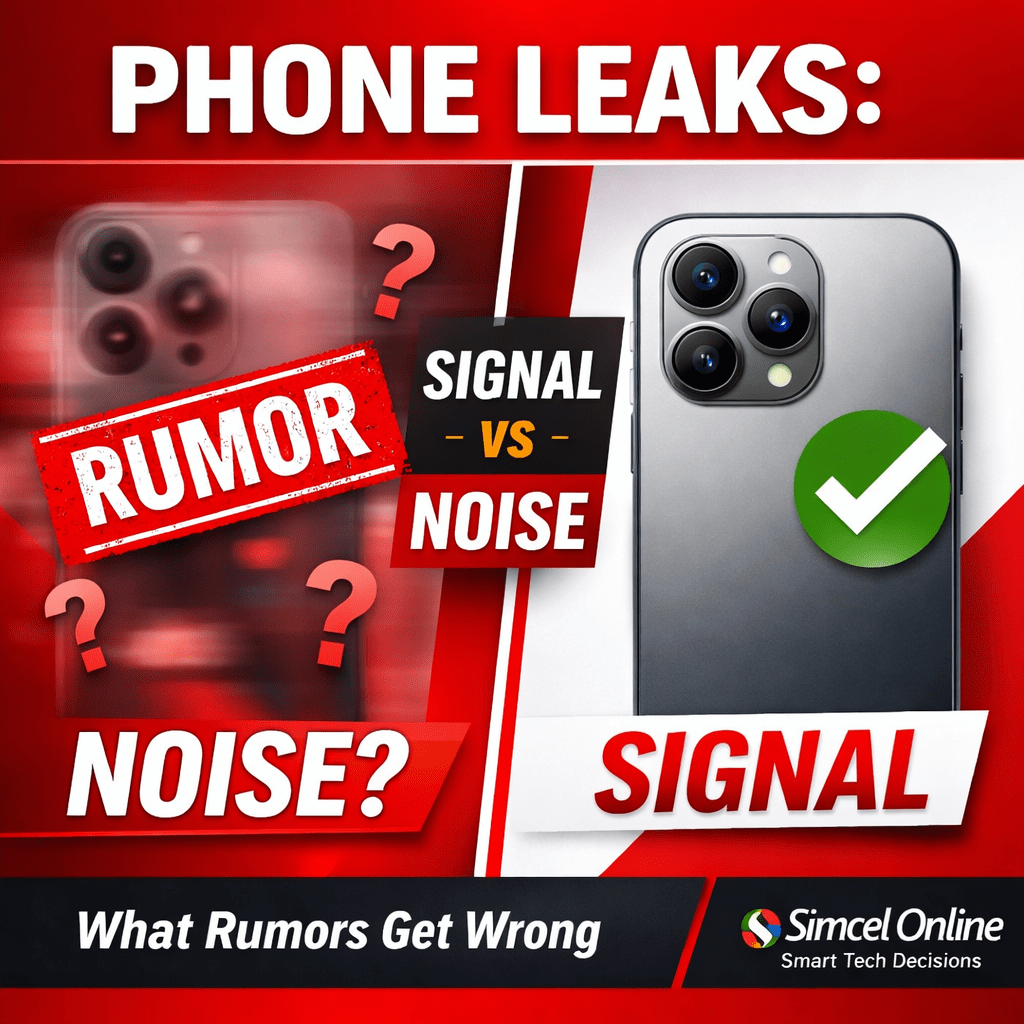
Every year, months before a major launch, the internet explodes with “leaks.”
New renders. Secret specs. “Confirmed” features. Anonymous insiders.
And yet, when the actual phone launches, half of those leaks quietly disappear.
If you run a phone business like Simcel Ventures, create tech content, or just want to buy smart, you need one skill: separating signal from noise.
Let’s break this down properly.
1. Concept Renders Are Not Final Designs
Most viral “leaked images” are:
- CAD files sent to case manufacturers
- Early prototypes
- Designer concepts
- Fan-made renders
These are not finished products.
What Usually Goes Wrong:
- Camera modules change
- Bezels shrink or grow
- Buttons move
- Materials switch (plastic → glass, aluminum → titanium)
By the time companies like Samsung or Apple announce their phones, design tweaks have happened multiple times internally.
Lesson: Treat early images as direction, not destination.
2. Specs Are Often “Testing Configurations.”
Leaks love numbers:
- 200MP camera
- 6000mAh battery
- 3.5GHz chipset
- 24GB RAM
But here’s what most people don’t understand:
Manufacturers test multiple configurations before launch.
For example:
- One version may test a 5000mAh battery.
- Another test 5200mAh.
- The final product ships with 5100mAh.
When rumors talk about the next Samsung Galaxy S26 or iPhone 18, they’re often reporting what’s being tested, not what’s confirmed.
Lesson: A spec leak is not a promise. It’s a possibility.
3. Camera Upgrades Get Exaggerated
Camera rumors are the most misleading.
You’ll see headlines like:
“Revolutionary Camera Upgrade!”
But in reality:
- Same sensor, new image processing
- Slight aperture improvement
- Minor zoom adjustment
When the final device launches, the difference is usually software optimization, not a dramatic hardware change.
Companies like Google prove this yearly with the Google Pixel line — computational photography often matters more than megapixels.
Lesson: Ignore megapixel hype. Watch for sensor size and processing upgrades.
4. Release Dates Are Frequently Misread
Leaks often confuse:
- Internal testing schedule
- Manufacturing ramp-up
- Announcement date
- Retail availability
For example:
- Production starting in July does NOT mean August release.
- Certification filings don’t mean immediate launch.
Retailers and resellers who rely blindly on leak timelines often overstock or underprepare.
If you’re running a business like Simcel Ventures, guessing launch dates from rumors is risky inventory management.
Lesson: Wait for official event invites.
5. “Insiders” Have Different Accuracy Levels
Not all leakers are equal.
There are:
- Proven supply-chain sources
- Analyst predictions
- Random social media guessers
Some have strong track records. Others are farming engagement.
Before believing a rumor, ask:
- Has this source been accurate before?
- Are multiple credible sources saying the same thing?
- Is the claim technically realistic?
A signal appears when independent sources align.
Noise appears when only one loud account is pushing it.
6. Marketing Strategy Changes Late
Here’s something people rarely consider:
Even if a feature is real, it can be:
- Canceled
- Delayed
- Region-specific
- Software-locked
Companies like Xiaomi and OnePlus sometimes adjust features depending on market response or competition pressure.
So a leak might be accurate in March — and outdated by June.
7. Why Leaks Still Matter
Now let’s be balanced.
Leaks are not useless.
They help:
- Buyers decide whether to wait or buy now
- Retailers plan inventory
- Content creators prepare marketing
- Competitors adjust strategy
But smart readers treat leaks as trend indicators, not confirmed reality.
How to Separate Signal From Noise (Practical Framework)
Here’s a simple filter you can use:
✅ Strong Signal
- Comes from supply chain reports
- Backed by certification listings
- Confirmed by multiple credible analysts
- Technically realistic
⚠️ Weak Signal
- Single anonymous source
- Unrealistic spec jumps
- No supporting documentation
- Clickbait headlines
The Real Power Move
If you’re in business — especially in Ghana’s competitive phone market — hype can cost you money.
Don’t:
- Pre-sell unconfirmed features
- Promise customers rumored specs
- Order inventory based on Twitter excitement
Do:
- Monitor trends
- Track official announcements
- Position your marketing around confirmed value
That’s how brands grow sustainably.
Leaks are part of the tech ecosystem.
But discipline separates professionals from hype followers.
The next time you see a “Confirmed Leak” headline, pause and ask:
Is this signal — or just noise?
If you master that filter, you won’t just consume tech news.
You’ll use it strategically.


 SIMCEL ONLINE
Leave a Reply