
When customers walk into a phone shop, they usually ask:
- “How many megapixels?”
- “Is it 5G?”
- “Is it 256GB?”
- “Is it the latest model?”
But here’s the truth:
Most people compare phones the wrong way.
If you’re serious about getting value for your money — especially in markets like Ghana where every cedi counts — you need to focus on the specs that actually affect daily performance.
Let’s break it down clearly.
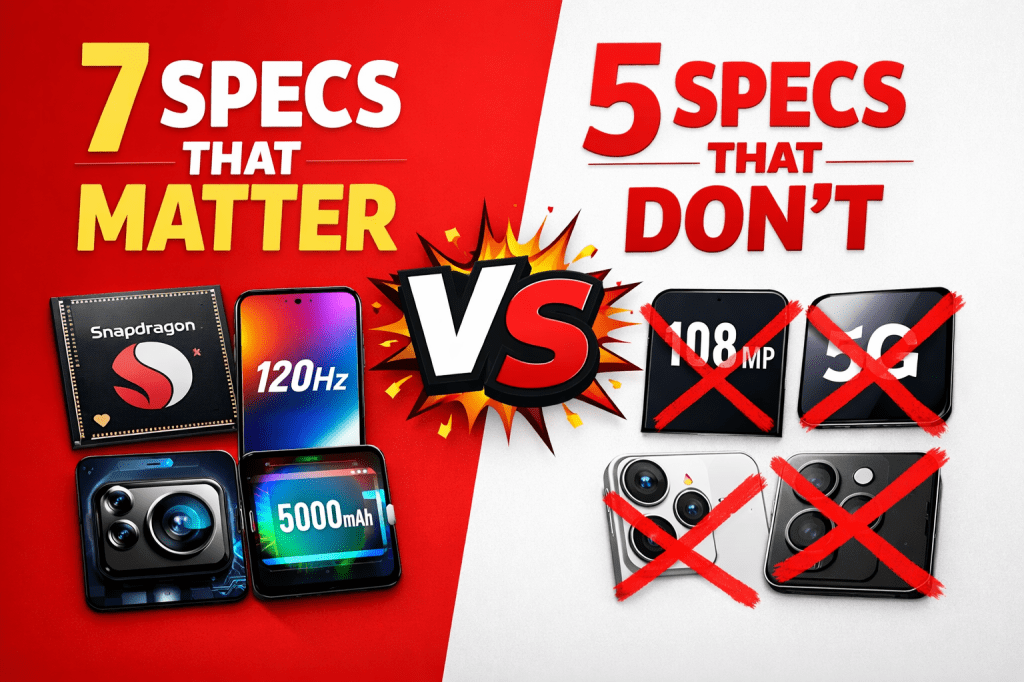
✅ The 7 Specs That Actually Matter
1. Processor (Chipset) – The Real Engine
This is the brain of the phone. It determines:
- Speed
- Gaming performance
- Multitasking
- Long-term smoothness
A phone with a strong processor and 6GB RAM will outperform a phone with a weak processor and 8GB RAM.
Examples:
- Flagship chips: Snapdragon 8 series, Apple A-series
- Strong midrange: Dimensity 800/900 series
If you get this wrong, nothing else saves the phone.
2. RAM (But Only Up to a Point)
RAM affects multitasking.
- 4GB – Basic use
- 6GB – Smooth daily usage
- 8GB+ – Heavy users & gaming
But don’t be fooled by “12GB RAM” on a weak processor. That’s marketing.
For 90% of users, 6GB–8GB is enough.
3. Battery Capacity + Charging Speed
Battery life is not just about mAh.
Look at:
- 5000mAh or higher (ideal)
- Charging speed (25W, 33W, 67W etc.)
- Processor efficiency
A balanced phone gives:
- Full-day battery
- 0–100% in 60–90 minutes
That’s practical value.
4. Display Quality (Not Just Size)
Ignore “6.7 inches” hype.
Focus on:
- AMOLED vs LCD
- 90Hz or 120Hz refresh rate
- Full HD+ resolution
- Brightness (important for Ghana sun)
A good display changes your experience every single day.
5. Storage Type (Not Just Storage Size)
People shout “256GB!”
But ask: What type of storage?
- UFS (faster)
- eMMC (slower)
Fast storage = faster app loading and smoother performance.
This is rarely advertised clearly — but it matters.
6. Software Support (Updates)
A phone isn’t just hardware.
Check:
- How many years of Android updates?
- How many security patches?
- Brand reputation for updates?
A cheaper phone without updates becomes slower and less safe faster.
7. Camera Sensor Quality (Not Just Megapixels)
More megapixels ≠ means better photos.
What matters:
- Sensor size
- Image processing
- Night performance
- Video stabilization
A well-optimized 50MP camera can beat a poorly optimized 108MP one.
❌ The 5 Specs That Usually Don’t Matter (As Much As You Think)
Let’s clear the hype.
1. Megapixels (Beyond 50MP)
After 50MP, it’s mostly marketing unless the sensor is large and well-optimized.
2. 5G (For Most Users in Ghana)
Unless you’re in an area with strong 5G infrastructure, it doesn’t change daily usage much compared to strong 4G.
3. Screen Size
6.5 vs 6.7 inches?
That’s preference — not performance.
4. Number of Camera Lenses
Three cameras don’t mean better photos.
Sometimes:
- 1 good camera > 4 weak cameras
5. Brand New Model Year
“2026 model” doesn’t automatically mean better than a strong 2024 flagship.
Specs > release year.
Smart Buyer Framework (Use This Instead)
When comparing two phones, ask:
- Which has the better processor?
- Is RAM sufficient (6–8GB)?
- Is the battery at least 5000mAh with fast charging?
- Is the display AMOLED and 90Hz+?
- Does it get long-term software updates?
If the phone passes these five checks, it’s likely a smart buy.
Advice (From a Business Mindset)
As someone building tech-focused brands like Simcel Ventures, you should understand this:
Smart buyers don’t chase hype. They chase value.
When you educate your customers using this framework:
- You build trust.
- You increase repeat sales.
- You position your brand as an authority.
And in business, authority is more powerful than discounts.


 SIMCEL ONLINE
Leave a Reply