
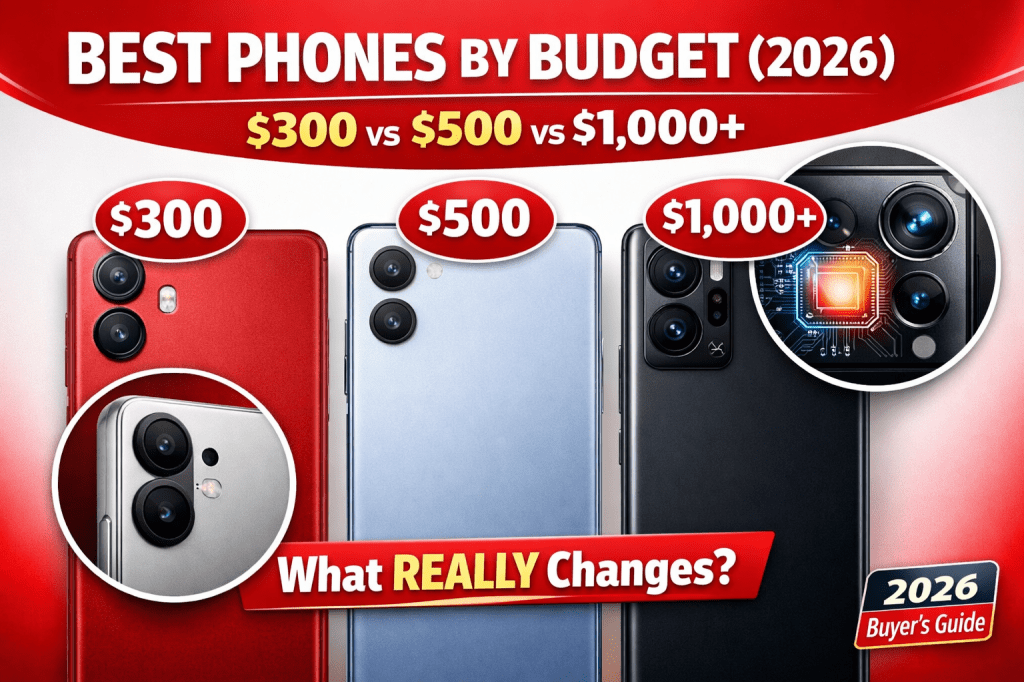
If you walk into a phone shop today — especially in Accra — you’ll hear things like “It’s 108MP,” “It’s 5G,” “It’s AI-powered,” “It’s flagship level.”
But here’s the real question:
👉 What actually changes when you move from $300 to $500… and then to $1,000+?
Because not everyone needs a $1,200 phone.
And not every $300 phone is a “budget compromise” anymore.
Let’s break it down clearly — no hype, just value.
🔹 Around $300 (Mid-Range Sweet Spot)
Typical Phones in This Range
- Samsung Galaxy A17
- Redmi Note 14
- Infinix Zero 30 5G
- Tecno Camon 30 5G
What You Get:
✅ 120Hz AMOLED or LCD display
✅ 5G support
✅ 50MP–108MP main camera
✅ 5,000mAh–5,500mAh battery
✅ Decent gaming performance
✅ 6–8GB RAM
What You Don’t Get:
❌ Flagship-level camera processing
❌ Premium build (mostly plastic)
❌ Top-tier chipsets
❌ Wireless charging
Who Should Buy This?
- Students
- First-time smartphone buyers
- Business owners who need WhatsApp, Facebook, TikTok, and banking apps
- People upgrading from older 4G phones
💡 Truth: In 2026, $300 phones are extremely powerful. For 70% of people, this is more than enough.
🔹 Around $500 (Upper Mid-Range Power)
Typical Phones in This Range
- Samsung Galaxy S24 FE
- Google Pixel 8a
- iPhone SE
- OnePlus Nord 4
What Changes Here?
🔥 Noticeable camera improvement
🔥 Faster processors (near-flagship chips)
🔥 Better low-light photography
🔥 Premium glass & metal design
🔥 Longer software support
Performance Difference
Compared to $300 phones:
- Apps open faster
- Gaming is smoother
- Video recording quality improves significantly
- AI features work better
Who Should Buy This?
- Content creators
- Business professionals
- People who keep their phones for 3–5 years
- Heavy multitaskers
💡 Real Talk: This is the smartest long-term investment category. You’re not overpaying for brand prestige, but you’re getting serious power.
🔹 $1,000+ (True Flagship Experience)
Flagship Examples
- iPhone 16 Pro Max
- Samsung Galaxy S25 Ultra
- Google Pixel 9 Pro
- OnePlus 13 Pro
What You’re Really Paying For:
🚀 Elite camera systems (periscope zoom, pro video tools)
🚀 Best processors on the market
🚀 Titanium or premium materials
🚀 Advanced AI integration
🚀 Wireless charging + reverse charging
🚀 4–7 years of software updates
Is It Worth It?
Let me be honest.
If you:
- Create high-end content
- Shoot professional-level video
- Want the absolute best display
- Care about prestige & ecosystem
Then yes.
But if you mostly:
- Use social media
- Make calls
- Watch YouTube
- Do light business tasks
You probably don’t need $1,000+.
What Actually Changes Between Budgets?
| Feature | $300 | $500 | $1,000+ |
|---|---|---|---|
| Display | Good | Very Good | Best in class |
| Camera | Solid | Excellent | Professional |
| Processor | Mid-range | Near-flagship | Elite |
| Build | Plastic | Glass/Metal | Premium materials |
| Longevity | 2–3 yrs | 4–5 yrs | 5+ yrs |
| AI Features | Basic | Advanced | Cutting-edge |
Advice (Especially for Ghana Buyers )
Don’t buy based on:
- Megapixels
- Hype
- Peer pressure
- “This is what influencers use.”
Buy based on:
- What you actually do daily
- How long do you plan to keep it
- Your income stability
- Battery needs
Spending $1,200 when you earn modestly is not “status.”
It’s poor financial judgment.
A smart buyer matches performance to purpose.
In 2026:
- $300 phones are powerful enough for most people
- $500 phones are the best value long-term
- $1,000+ phones are luxury-performance tools
The difference isn’t just specs.
It’s camera processing, chipset power, materials, and software longevity.
If you’re unsure which category fits you, choose based on how you use your phone — not what looks impressive online.
If you want help choosing the best option available in Ghana right now, visit Simcel Online or reach out to Simcel Ventures for honest recommendations.
Buy smart. Not expensive.


 SIMCEL ONLINE
Leave a Reply