
What Machiavelli Has Taught Me About Power, Virtù, Fortune, and Civic Freedom.
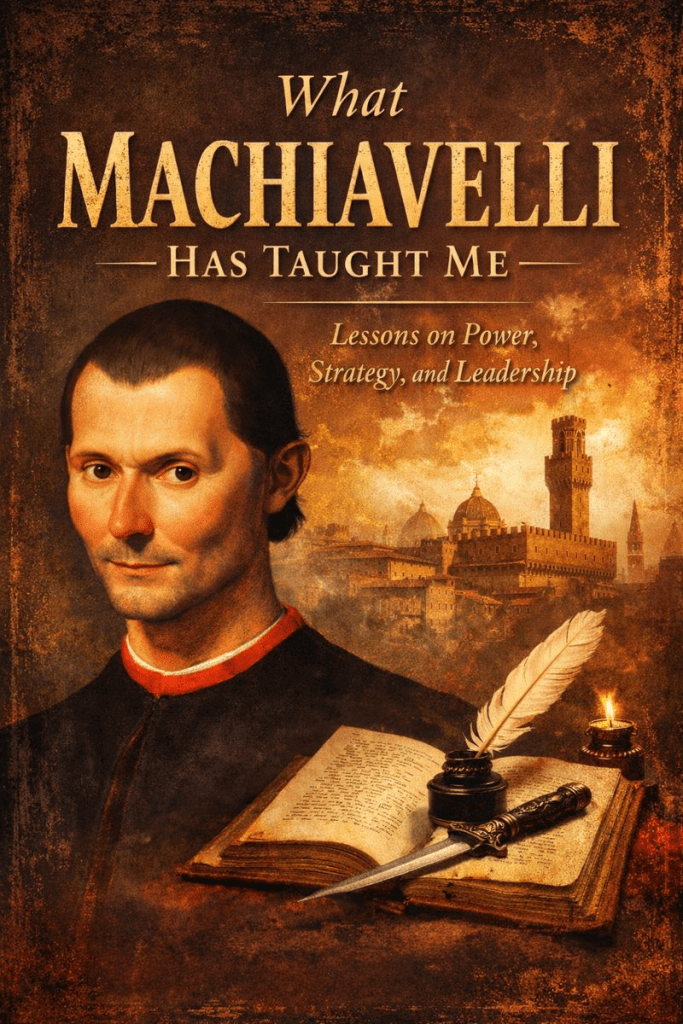
Niccolò Machiavelli’s writings are often invoked to justify ruthless politics, cut‑throat business and “Machiavellian” manipulations. The reality is both more subtle and more profound. Writing in the turbulent Italian Renaissance, Machiavelli searched for the “effectual truth” of politics – the real dynamics of power as he observed them, stripped of the idealism of philosophers and moralists. He believed that politics deserved to be studied on its own terms, not as a branch of ethics. His little book The Prince (1513) and the later Discourses on Livy contain sharp observations on leadership, liberty and human nature that continue to resonate in modern political science and management. This 12‑chapter book is a personal reflection on “what Machiavelli has taught me.” Each chapter explores a theme from his works, places it in historical context and considers its relevance today. Where appropriate, the narrative draws on scholarly commentary to correct distortions and highlight nuance.
Chapter 1 – A Florentine Life: Machiavelli’s World and Biography
Niccolò di Bernardo dei Machiavelli was born in Florence on 3 May 1469 during a vibrant period of civic prosperity and artistic achievement. His father, Bernardo, was a lawyer from the old Florentine nobility, and his mother Bartolommea came from the respected Nelli family. Florence in the late fifteenth century oscillated between the religiosity of Savonarola and the magnificence of Lorenzo de’ Medici, offering the young Machiavelli an education in contrasts. Little is known about his youth, but his later letters reveal that he devoted himself to study, advising his own son to take advantage of youth to pursue letters and music.
Machiavelli’s political career began in 1494, when the Medici family was expelled and a republican government took power in Florence. Four years later he was appointed Chancellor and Secretary to the Second Chancery, responsible for diplomatic correspondence and the militia. His diplomatic missions took him to courts across Europe – to Caterina Sforza in Forlì in 1499, to Louis XII of France in 1500 and to the papal court in Rome several times. These missions exposed him to the strategies of monarchs, the ambitions of Cesare Borgia and the complex alliances of Italian city‑states. He saw first‑hand how fortresses could not secure power if the people were hostile, how France’s errors in statecraft allowed it to be driven out of Italy and how Pope Julius II’s impetuous character sometimes succeeded where caution would have failed. These experiences later provided concrete examples for his arguments about the importance of civic support and the dangers of mercenary armies.
When the Medici returned to power in 1512, Machiavelli was dismissed, accused of conspiracy and tortured. After his release he retired to his farm at San Casciano, near Florence. In a letter to his friend Francesco Vettori dated 13 December 1513, he described his exile: during the day he worked with peasants and read in his study, and at night he donned “noble court dress” and conversed in his imagination with the ancient philosophers, recording his insights for a treatise on principalities. This treatise would become The Prince, a slim volume dedicated to Lorenzo de’ Medici that he hoped would restore him to favour, though the dedication was never fulfilled. He continued to write histories, comedies and dialogues until his death on 22 June 1527.
Machiavelli’s life was intertwined with the fortunes of Florence. The republic’s rise gave him his career; its fall into Medici hands cost him his office; and his exile gave him the solitude to formulate a political philosophy that still captivates readers. Understanding his biography illuminates why he was concerned above all with the survival of the state and the effectiveness of leadership, not with moral perfection. His experiences with treacherous alliances, mercenary troops and shifting public opinion shaped his belief that political leaders must be flexible and pragmatic. Those experiences also taught him that fortune – the unpredictable force governing human affairs – can upend even the most carefully laid plans, a theme explored throughout this book.
Chapter 2 – The Break with Ethical Politics: Realism and the “Effectual Truth”
Before Machiavelli, Western political thought largely viewed politics as a branch of ethics. From Aristotle to Thomas Aquinas, politics was believed to aim at cultivating virtue and the good life. Machiavelli broke decisively with this tradition. In The Prince he insists that there is a “gap between how one lives and how one should live” and that those who ignore this gap court ruin. Robert Harrison notes that Machiavelli was the first theorist to separate politics from ethics and give politics “a certain autonomy”. Politics is concerned with power, stability and survival. Ethical ideals may be admirable, but a ruler who clings to them without regard for circumstances will lose power and thus fail his people.
Machiavelli’s realism is often caricatured as advocating cruelty for its own sake. His famous recommendation that it is “much safer to be feared than loved” if a ruler cannot achieve both is frequently misquoted as “better to be feared than loved,” implying that he relishes tyranny. In reality, Machiavelli’s advice is conditional. He acknowledges that the ideal is to be both loved and feared, and only when that balance cannot be achieved does fear become the safer option. Even then he warns against gratuitous cruelty, for excessive violence breeds hatred and endangers stability. He repeatedly advises princes to avoid being despised or hated.
The root of Machiavelli’s realism lies in his view of human nature. People, he argues, are “ungrateful, fickle, liars and deceivers… avoiders of danger, greedy for profit”. They will support a ruler as long as he serves their interests; when times turn bad, they abandon him. Therefore a prince should not rely on promises of loyalty but must secure his position by other means. This view may seem cynical, but Machiavelli sees it as a factual observation gleaned from history and experience. Politics deals with imperfect people and dangerous circumstances, so the question for him is not how to be morally pure but how to be effective without losing sight of the state’s wellbeing.
Machiavelli’s critics often accuse him of amoralism or immorality. Some, like Leo Strauss, call him a “teacher of evil” who recommends cruelty and deceit. Others, such as Benedetto Croce, see him as a realist who suspends moral judgments in political decision‑making. Quentin Skinner interprets Machiavelli as advising that rulers commit evil only as a “last best” option. Modern readers should neither glorify Machiavellian ruthlessness nor dismiss his insights outright. His realism invites us to examine the often uncomfortable tension between morality and political necessity. By separating politics from ethics, he opened the door to a more empirical, less idealistic study of power relations that has influenced modern political science and management theory.
Chapter 3 – Virtù: The Art of Adaptability
Central to Machiavelli’s thought is the concept of virtù – a term that resembles “virtue” but takes on a very different meaning. In Italian it carries connotations of strength, skill, prowess, character and ingenuity. Machiavelli uses it to describe the qualities a leader must cultivate to maintain power and achieve great things. These qualities include courage, decisiveness, foresight, cunning and above all flexibility. A prince of virtù must be prepared to vary his conduct “from good to evil and back again as fortune and circumstances dictate”. In other words, he must be adaptable. Sticking rigidly to one mode of behaviour is a recipe for failure.
Machiavelli illustrates virtù through analogies with warfare. In his dialogue The Art of War, he uses the word to describe the strategic prowess of a general who adapts to different battlefield conditions. Politics, he argues, is like war on another scale; thus, a ruler needs to master strategies appropriate to each situation. An adaptable prince can read the times and modify his approach accordingly. If times call for boldness, he must be bold; if caution is required, he must be cautious. Machiavelli’s examples of historical rulers, such as Cesare Borgia and Pope Julius II, underscore that success depends on matching one’s character to the circumstances. Pope Julius’s impetuousness served him well because his times required bold action; had circumstances changed, the same qualities might have caused his downfall.
To cultivate virtù, Machiavelli suggests that leaders study history and learn from the successes and failures of others. He compares princes to archers who aim higher than the target so that, if they fall short, they will still hit the mark. Similarly, a prince should aim for excellence by observing exemplary leaders and adapting their techniques to his own context. Virtù is not inherent; it is cultivated through experience, study and reflection. Machiavelli himself spent his exile studying classical texts and contemporary politics, and he encouraged his son to “study letters and music” because knowledge brings honour.
Importantly, virtù does not equate to moral goodness. Machiavelli explicitly states that a prince may need to act “contrary to fidelity, friendship, humanity and religion” to preserve the state. However, he also counsels that the prince should not diverge from the good if he can avoid doing so. The emphasis is on prudence: knowing when circumstances permit virtuous actions and when they require harsh measures. To maintain power and public order, the prince must sometimes mask his intentions and present himself as merciful, faithful, humane, upright and religious, even if he does not always adhere to these qualities. Appearance matters because “everyone sees what you appear to be, few really know what you are”.
Chapter 4 – Fortuna: Navigating the Tide of Fortune
Alongside virtù, Machiavelli introduces Fortuna – the unpredictable force that shapes human affairs. Classical tradition depicted Fortuna as a fickle goddess who bestows both good and bad luck. Machiavelli portrays fortune as a more malevolent and uncompromising force, “the ultimate threat to the safety and security of the state”. Fortune’s capriciousness means that even the most capable ruler cannot control all events; sometimes floods, wars or conspiracies will overwhelm even the prepared. Yet Machiavelli rejects fatalism. He argues that fortune governs only part of our actions, leaving the rest under human control. In a letter, he compares fortune to a violent river: when it is calm, prudent men build dikes and embankments to mitigate future floods. Similarly, a prince must prepare in advance by developing the capacity to respond to unforeseen crises.
The relationship between virtù and Fortuna defines Machiavelli’s political philosophy. Virtù allows a leader to respond to fortune’s blows and to exploit opportunities when they arise. If fortune is like a raging river, virtù is the engineering skill that channels it. Machiavelli illustrates this dynamic in his discussion of the French monarchy. Although France’s constitutional laws and its Parlement create a secure and orderly state, Machiavelli notes that the kingdom remains vulnerable because the French king disarmed his people and relied on foreign mercenaries. When fortune brings external threats, a disarmed populace cannot defend itself. A wise ruler anticipates such dangers by arming and preparing citizens, thereby reducing dependence on fortune and foreigners. Machiavelli’s later Discourses explicitly assert that the liberty of a state depends on military preparedness and the civic virtue of its citizens.
Modern management scholars have drawn parallels between Fortuna and market volatility or technological disruption. Leaders today must accept that external shocks will occur—economic crises, pandemics, supply‑chain disruptions—and plan accordingly. Machiavelli teaches that while we cannot control every external event, we can build resilient institutions and cultivate adaptable habits. The metaphor of building embankments anticipates contemporary risk management and scenario planning. By acknowledging uncertainty rather than denying it, leaders can avoid being blindsided by fortune.
Chapter 5 – Fear and Love: Human Nature and Leadership
One of the most cited chapters of The Prince addresses whether it is better for a ruler to be feared or loved. Machiavelli’s answer is widely misunderstood. He writes that while it would be ideal to be both loved and feared, if one cannot achieve both it is “much safer to be feared than loved”. He justifies this by offering a sober view of human nature: people are fickle and self‑interested; they remain faithful as long as it benefits them but turn against a ruler at the first sign of danger. Fear, rooted in the dread of punishment, is more stable than love, which depends on obligation and can be broken. Jeffrey Sonnenfeld reminds us that Machiavelli did not celebrate cruelty; he preferred that rulers be both loved and feared, and only when that was impossible did he consider fear the safer option.
Importantly, Machiavelli warns against arbitrary cruelty. In Chapter 17 he advises that a ruler should avoid hatred. People will forgive many things, but they will not forgive the seizure of their property or personal honour. Excessive violence breeds resentment and undermines legitimacy. Instead, Machiavelli recommends that if harsh actions are necessary, they should be swift, decisive and not repeated. Mercy should be used to win goodwill when possible. This counsel reflects his broader principle of prudence: balancing firmness with moderation to secure the state without engendering unnecessary hostility.
The broader lesson concerns incentives and motivations. Fear works because consequences are immediate and tangible. Love, based on gratitude or affection, is unstable when interests conflict. Modern leaders can translate this into clear systems of accountability and consequences, while also seeking to inspire loyalty through fair treatment and shared purpose. Machiavelli’s insight remains relevant in governance, corporate management and even parenting: effective authority balances rewards and punishments while being mindful of human psychology.
Chapter 6 – The Prince’s Handbook: Types of Principalities and the Acquisition of Power
In the opening chapters of The Prince, Machiavelli classifies principalities—hereditary, new and mixed—and examines how they are acquired and held. Hereditary states, he notes, are easier to maintain because subjects are accustomed to the ruling family. New principalities acquired by one’s own arms and ability demand greater virtù. Machiavelli analyses historical examples such as Cesare Borgia, whom he both admires and criticizes. Borgia was bold and decisive, using cruelty strategically to pacify the Romagna and earning a reputation for effectiveness. Yet he ultimately failed because his power depended on the fortune of his father, Pope Alexander VI, and collapsed when the pope died. Machiavelli thus distinguishes between rulers who come to power by virtù and those who rely on the arms and fortune of others.
Chapter 12 of The Prince discusses different kinds of military forces—one’s own troops, mercenaries, auxiliaries or mixed soldiers. Mercenaries and auxiliaries, he warns, are “useless and dangerous”. They lack discipline, are motivated only by pay and flee when war comes. Italy’s ruin, Machiavelli argues, stemmed from relying on mercenary armies. Auxiliaries—troops lent by another ruler—are even more dangerous, since they may either lose, leaving you unprotected, or win and then dominate you. Therefore, a wise prince should rely on his own citizens, either personally leading them or ensuring that competent commanders are loyal. He cites Rome and Sparta as examples of free states that remained armed and independent for centuries.
This emphasis on self‑reliance has modern parallels. Organizations that outsource core functions or depend exclusively on consultants may find themselves vulnerable. Building internal capacity—the corporate equivalent of citizen militias—provides resilience and aligns incentives with the organization’s success. Machiavelli’s critique of mercenaries is not a rejection of specialization, but a warning about dependence on actors whose primary loyalty lies elsewhere.
Chapter 7 – Republics and Monarchies: Lessons from the Discourses and the French Example
While The Prince focuses on the strategies of individual rulers, Machiavelli’s Discourses on Livy expresses his republican sympathies. In this work he contrasts different conceptions of political order: vivere sicuro (living securely) and vivere libero (living freely). A minimal constitutional order provides security by keeping the ambitions of nobles and commoners in check. But true liberty requires active participation and contestation between social orders. Machiavelli prefers republics because they allow for broader participation and because the competition between noble and popular interests produces better governance.
Machiavelli praises the French monarchy for its dedication to law. He writes that France “is moderated more by laws than any other kingdom”. The Parlement of Paris checks the power of nobles and even judges the king. This legal system prevents tyranny and provides security. Yet France remains a monarchy, and while its subjects live securely, they do not live freely. Machiavelli notes that most people confuse liberty with security, desiring to live safely rather than participate in self‑government. Those who desire freedom to command others are few and can be controlled or co‑opted. The majority are content if laws guarantee their safety.
Machiavelli’s critique of the French monarchy anticipates modern debates about security versus freedom. He argues that a state that prioritizes security will disarm its citizens, rely on foreign troops and thus create a passive populace. Such a state may enjoy temporary peace, but it becomes dependent on outsiders and is vulnerable to external threats. By contrast, republics arm their citizens and cultivate civic virtue, thereby ensuring both security and liberty. Machiavelli’s assertion that “Rome was free four hundred years and was armed; Sparta, eight hundred” conveys his belief that armed citizenship underpins freedom. For modern readers, the specific reference to arms should be taken metaphorically as the empowerment of citizens to participate meaningfully in their government. In democratic societies, education, voting rights and civic engagement are the tools through which citizens guard their liberty.
Chapter 8 – Liberty and Conflict: Managing Faction and Disagreement
The Discourses also emphasize the productive role of conflict in republics. Machiavelli rejects the ideal of harmony as the highest political good. Instead, he argues that liberty emerges from the competition between different social orders. The clash between the ambitions of the nobility (the grandi) and the desire of the people (popolo) for security and participation keeps each side in check. Without this balancing act, one group would dominate and oppress the other. Quentin Skinner points out that liberty functions as an anchoring value in Machiavelli’s political theory. The republican model ensures that no single individual or class can accumulate unchecked power.
Machiavelli also recognizes that conflict can become destructive. In the History of Florence he recounts how factions sometimes plunged the city into chaos. Yet his solution is not to eliminate conflict but to institutionalize it. Offices, councils and magistracies distribute power across different bodies and force elites to seek consensus. The Florentine constitution of 1494, for which he served as secretary, aimed to balance the gonfaloniere (chief administrator), councils of nobles and popular assemblies. Modern democratic systems similarly channel conflict through legislatures, courts and elections. When disagreements are processed through institutions, they produce policy and compromise rather than violence.
Machiavelli’s willingness to celebrate conflict challenges modern ideals of consensus. In business, internal debates can lead to better strategies if managed constructively. In civic life, robust public discourse prevents complacency and exposes shortcomings. The goal is not unity for its own sake but a dynamic equilibrium where competing interests restrain one another. By embracing conflict as a source of renewal, leaders can harness diversity of views instead of stifling dissent.
Chapter 9 – Religion, Morality and Civic Virtue
Machiavelli’s attitude toward religion has long been debated. He criticized the institutional Church for sapping the civic vigor of Italians, yet he also expressed admiration for the civic religion of ancient Rome and acknowledged that religious belief can strengthen social cohesion. Some scholars argue that Machiavelli was hostile to Christianity and preferred paganism. Others, like Sebastian de Grazia and Maurizio Viroli, find in his writings a respect for biblical themes and an acknowledgement of divine providence. Cary Nederman suggests that concepts such as grace, free will and prayer are present in Machiavelli’s framework. The ambiguity arises because Machiavelli treats religion instrumentally: he values its political effects more than its doctrinal truth.
In The Prince Machiavelli advises rulers to appear religious because people judge by appearances and religion commands respect. A prince must be seen as pious even if he is not devout, because such a reputation helps maintain authority. But he also warns against letting religious scruples undermine the state. If a religious obligation conflicts with political necessity, the prince must prioritise the latter. In the Discourses he praises Rome’s civil religion for uniting citizens and inspiring virtuous conduct. Festivals, oaths and rituals created a sense of common purpose and encouraged citizens to sacrifice for the republic. Machiavelli thus advocates a civic religion that promotes patriotism and obedience to law.
For modern leaders, this chapter’s lesson is that values and symbols matter in politics. Institutions rely on shared beliefs and rituals to foster trust and cooperation. Leaders who ignore these cultural dimensions risk losing legitimacy. However, Machiavelli would caution against allowing ideology to override practical concerns. Prudence requires balancing idealism with effectiveness. Encouraging civic virtue through education and public ceremonies can strengthen democratic life, but dogmatism can lead to rigidity and conflict.
Chapter 10 – The Modern State and Reason of State
Some scholars credit Machiavelli with introducing the modern concept of the state. By focusing on lo stato, an impersonal form of rule possessing a monopoly on coercive authority, he anticipates the Weberian understanding of the state. Yet Harvey Mansfield argues that Machiavelli’s state remains a personal patrimony, a possession of the prince rather than an impersonal institution. The prince’s “state” is literally owned by whoever controls it, and its character depends on his personal qualities. This personal nature of the state underscores why virtù is indispensable: the stability of government hinges on the leader’s skills and character.
Machiavelli’s focus on the state’s interests rather than moral considerations contributed to the doctrine of “reason of state,” later employed by absolutist rulers to justify actions taken for the benefit of the state over individual rights. Although he is often invoked as an advocate of raison d’état, his writings caution that power lacking legitimacy and support is precarious. He emphasizes that rulers who seize property or violate personal honor become hated and risk conspiracy.
Modern public administration owes much to Machiavelli’s insight that governing requires its own logic and expertise. Bureaucracies, constitutions and checks and balances seek to institutionalize virtù and reduce dependence on the personal qualities of rulers. Nevertheless, the leader’s character still matters, as the success of institutions often depends on the integrity and prudence of those who operate them. The challenge is to create systems resilient to weak leadership while enabling good leaders to steer effectively.
Chapter 11 – Machiavelli and Modern Leadership: Lessons Beyond Politics
Although Machiavelli wrote about princes and republics, his insights apply to modern leadership in business, nonprofit organizations and personal life. At Yale School of Management, Robert Harrison argues that The Prince remains relevant because it discloses a demoralized perspective on human nature and power. Leaders today must navigate competitive environments, manage stakeholders with divergent interests and make decisions under uncertainty. Machiavelli offers several lessons:
- Separate ideals from realities. Leaders should understand the difference between how people ought to behave and how they actually behave. Strategies should be grounded in factual analysis, not wishful thinking. This does not mean abandoning ethics, but recognizing that moral behaviour must be reconciled with practical constraints.
- Cultivate adaptability (virtù). The ability to adapt to changing circumstances is crucial. Organizations that rigidly follow a fixed plan may fail when markets or technologies shift. As Machiavelli notes, the prince must vary his conduct according to fortune and circumstances. Modern leaders can cultivate adaptability through continuous learning, scenario planning and flexible structures.
- Prepare for uncertainty (Fortuna). External shocks will occur. Leaders should build resilient systems—diversified supply chains, emergency funds, cross‑trained teams—to mitigate the impact of unforeseen events. This reflects Machiavelli’s counsel to build embankments before the river floods.
- Balance fear and love. Effective leadership requires earning respect and enforcing accountability while also inspiring and engaging followers. Over‑reliance on either fear or affection can backfire. Machiavelli warns against excessive cruelty and urges avoiding hatred.
- Invest in human capital. Machiavelli’s disdain for mercenary soldiers is a reminder that organizations should build internal capacity. Outsourcing critical functions can create dependency and vulnerability. Developing employees’ skills fosters loyalty and competence.
- Encourage constructive conflict. Diversity of opinions leads to innovation. Like the contest between nobles and citizens in the Florentine republic, healthy disagreement within organizations prevents groupthink and yields better solutions.
- Manage perceptions. Machiavelli stresses that appearance matters: everyone sees what you seem to be, few know who you really are. Leaders must communicate effectively, uphold consistent values and avoid actions that create mistrust. Transparency and authenticity, combined with strategic communication, build credibility.
These lessons show that Machiavelli’s insights extend beyond princely rule. They challenge modern leaders to be honest about human motivations, to prepare for uncertainty and to balance moral aspirations with practical necessities.
Chapter 12 – The Legacy and Misinterpretations of Machiavelli
Five centuries after the publication of The Prince, Machiavelli’s name has become synonymous with manipulation and deceit. Yet a closer reading reveals a more nuanced thinker. He does not celebrate cruelty for its own sake, but warns that cruelty must be swift and rare if used; he values liberty and civic participation, even while acknowledging that most people prefer security; he advocates religious appearances not to mock faith but to harness its unifying power. His counsel to princes to prepare for misfortune and to cultivate a flexible disposition remains relevant in a world where crises and disruptions are common.
Machiavelli has been labeled a “teacher of evil” and a cunning satirist. Jean‑Jacques Rousseau saw The Prince as a satire written to unmask tyrants rather than to instruct them. Others, like Mary Deitz, argue that Machiavelli crafted advice designed to entrap rulers by leading them to their own downfall. The diversity of interpretations speaks to the complexity of his work. Instead of adopting any single reading, we might view Machiavelli as an analyst of power who sought to understand it in all its forms—monarchical, republican, military and religious—and to teach how it might be harnessed for the common good.
For readers today, Machiavelli’s writings are an invitation to think critically about leadership and politics. They remind us that ethical ideals must contend with practical realities, that adaptability and preparation are indispensable and that appearances matter even in the most principled endeavours. His insistence on studying history to learn from past successes and failures is a timeless injunction. Whether we agree or disagree with his conclusions, engaging with Machiavelli forces us to confront uncomfortable truths about human nature and governance. By grappling with these truths, we can aspire to build institutions and communities that are both secure and free, pragmatic and principled.
Concluding Reflection
Machiavelli taught me that leadership is not about rigidly adhering to ideals nor about cynically abandoning them. It is about recognising the complexities of human behaviour, preparing for unpredictability and navigating the tensions between moral aspirations and practical necessities. He taught me to value adaptability, to build structures that withstand shocks and to appreciate that freedom flourishes through contestation and civic engagement. By separating politics from ethics, he did not banish morality but challenged us to think more deeply about how to achieve just outcomes in an imperfect world. His legacy is neither a manual for tyranny nor a roadmap for utopia; it is a mirror held up to politics and an enduring stimulus for reflection.


 SIMCEL ONLINE
Leave a Reply