
Why Understanding the “Why” Matters More Than the “What” in Education, Science, Business, Technology, and Personal Growth
Preface
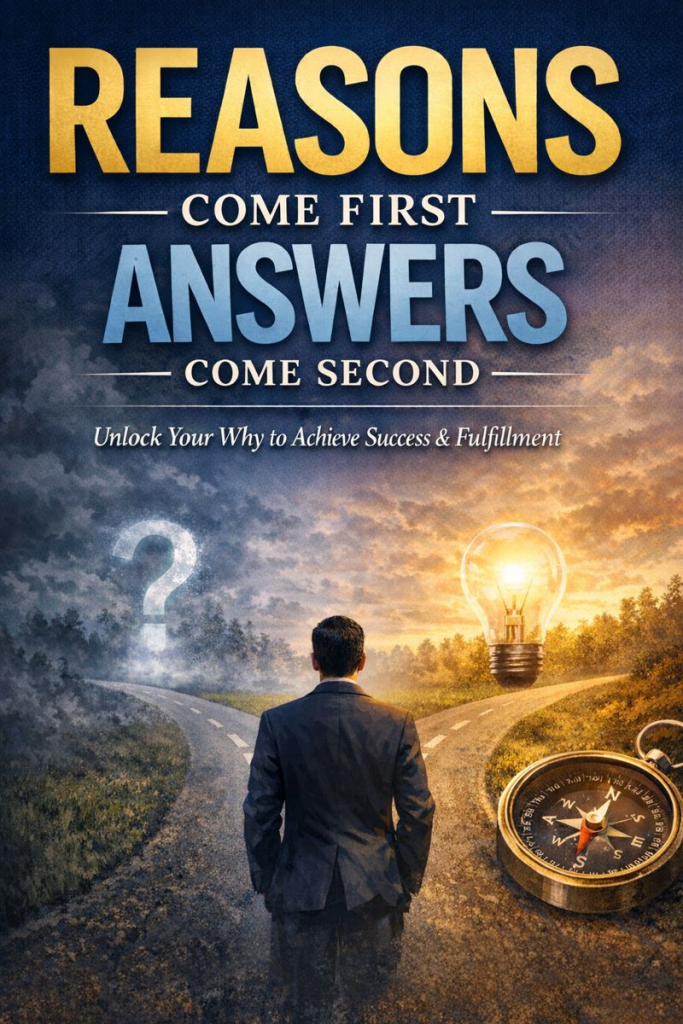
From a young age, we are conditioned to seek the right answer. At school, we are rewarded for filling in the correct bubble on an exam rather than explaining how we arrived at our conclusion. In professional settings, we are often expected to quickly deliver solutions and be judged by the results. Yet history and research show that focusing on answers before reasons can lead to brittle knowledge, poor decisions, and missed opportunities. This book argues that reasons come first and answers come second. When we understand why things work and why we believe what we believe, we make better decisions, innovate more effectively, and live more meaningful lives.
The phrase “reasons come first” does not mean that answers are unimportant. It means that good answers are built on solid reasoning. Throughout this book, you will encounter stories of scientists, engineers, teachers, policymakers, entrepreneurs, and everyday people who achieved great things by taking time to understand underlying principles before jumping to conclusions. You will also learn techniques for strengthening your own reasoning, from the Socratic method and the scientific method to design thinking and evidence‑based policymaking. My hope is that this book inspires you to slow down and ask “Why?” before accepting any answer.
Chapter 1: Introduction — The Primacy of Reason
Our world prizes answers. Students are graded based on the answers they give on standardized tests. Professionals are rewarded for producing solutions quickly. Leaders are applauded for decisive actions. In this environment, it is easy to conflate having an answer with having knowledge. Yet as Nobel laureate Richard Feynman once noted, “I don’t know what’s the matter with people: they don’t learn by understanding; they learn by some other way—by rote or something. Their knowledge is so fragile”. Feynman recognized that memorized answers without underlying understanding are fragile. When circumstances change, rote learners falter because they lack the conceptual framework to adapt.
The philosopher Ludwig Wittgenstein offered a contrasting view of understanding: “To understand is to know what to do. This definition emphasizes that genuine understanding is actionable—it equips us to navigate new situations. Understanding flows from reasoning, the process of building knowledge from evidence, logic, curiosity, and reflection. In contrast, an answer is a result—a snapshot of knowledge at a particular moment. Answers are invaluable when built on strong foundations, but they are flimsy when disconnected from the reasoning that produced them.
First‑Principles Thinking
One way to ensure that answers rest on solid foundations is to engage in first‑principles thinking. As the Farnam Street mental models guide explains, first‑principles thinking involves breaking a problem down to its most basic, irreducible truths and then reconstructing solutions from those elements. Rather than accepting assumptions at face value, first‑principles thinkers strip away layers of convention to identify what is absolutely true in a given context. This approach allows them to generate innovative solutions instead of making incremental tweaks. The article notes that when we reason from first principles, we separate truths from assumptions. By doing so, we can build new structures of knowledge rather than simply rearranging existing pieces.
Children instinctively apply first‑principles thinking. Anyone who has spent time with a toddler knows the relentless barrage of “Why?” questions. Farnam Street notes that Socratic questioning and the Five Whys technique both mimic this childlike curiosity. The Socratic method involves clarifying one’s thinking, challenging assumptions, seeking evidence, considering alternative perspectives, examining consequences, and questioning the original questions. Each step digs deeper into the reasoning behind a claim and forces us to distinguish knowledge from ignorance. The Five Whys technique, developed by Sakichi Toyoda and popularized by Toyota, instructs us to ask “Why?” repeatedly until we uncover the root cause of a problem. Both methods prioritize understanding over immediate answers.
The Seduction of Quick Answers
If reasoning is so valuable, why do we rush to answers? Human brains are wired to close loops. Psychologists refer to the Zeigarnik effect, the tendency to remember unfinished or interrupted tasks more easily than completed ones. The lingering tension associated with open questions motivates us to seek closure. However, the drive to complete tasks can lead to premature closure—settling on the first plausible answer rather than patiently investigating underlying causes. In the business world, this impulse manifests as “fixing” symptoms without addressing root causes. In education, it emerges when students memorize facts without understanding how those facts connect. In personal life, it appears when we leap to conclusions about people’s motivations or our own feelings without introspection.
Recognizing this cognitive tendency is the first step toward countering it. We must train ourselves to sit with uncertainty long enough to conduct thoughtful inquiry. The rest of this book presents tools and perspectives for doing just that. By the end, you will understand why reasons come first and how to apply reasoning across diverse domains.
Chapter 2: Philosophical Foundations of Reasoning
Throughout history, great thinkers have emphasized the primacy of reasoning. The Western philosophical tradition traces first principles back to Plato, Aristotle, and Descartes. These philosophers sought foundational truths that could support entire systems of thought. Aristotle’s Metaphysics introduced the concept of first principles—statements that cannot be deduced from more basic propositions. Rene Descartes advocated systematic doubt, recommending that we doubt everything that could possibly be doubted until only indubitable truths remain. This Cartesian doubt is itself a form of first‑principles thinking.
The Socratic dialogues provide an early model of reasoning through questions. Socrates rarely offered definitive answers; instead, he asked probing questions that forced interlocutors to examine their assumptions. This method is captured in the Socratic questioning process described by Farnam Street: clarify thinking, challenge assumptions, seek evidence, consider alternatives, examine consequences, and question the original questions. Each step fosters deeper understanding by focusing on reasons instead of rushing to conclusions.
In modern times, first‑principles thinking has been championed by scientists and entrepreneurs. James Clear’s analysis of Elon Musk’s engineering decisions illustrates how this ancient philosophical approach drives contemporary innovation. Musk confronted the high cost of rocket manufacturing by asking what a rocket is made of—identifying the fundamental components of aerospace materials—and discovered that the raw materials cost a fraction of the price of finished rockets. By reconstructing rockets from their basic elements, he built SpaceX and dramatically reduced launch costs. Clear notes that first‑principles thinking requires boiling processes down to fundamental parts and rebuilding solutions from there. This mindset has underpinned major innovations, from Gutenberg’s printing press to modern technology.
The Importance of Skepticism
Reasoning starts with skepticism—the willingness to question claims and examine evidence. Skepticism is not cynicism; rather, it is a recognition that human perception and memory are fallible. We are prone to biases, heuristics, and social pressures that distort our thinking. The Socratic method seeks to strip away these distortions by asking foundational questions. So does the scientific method, which we explore in detail later. Philosophers from David Hume to Karl Popper emphasized that our beliefs must be continuously tested against observations. As Feynman observed, knowledge built on rote memorization is fragile, whereas knowledge built on understanding endures.
Analogy Versus First Principles
Many everyday decisions are based on analogy—copying what worked before. Analogy is useful because it leverages existing solutions, but it has limitations. As Clear notes, innovators often get trapped in optimizing form rather than function. For centuries, people improved luggage by making better bags, yet no one combined a bag with wheels until the late 20th century. First‑principles thinking asks: What is the function of luggage? How can we move items more easily? By reframing the problem, designers created rolling suitcases.
When we rely on analogy alone, we may never question underlying assumptions. We mimic established patterns because they seem to work. The first‑principles approach requires us to question those patterns and ask whether they are truly optimal. That mindset demands courage—challenging conventional wisdom can be uncomfortable. Yet it also yields breakthroughs. Whether designing a rocket, crafting a policy, or making a personal decision, asking “Why does it have to be this way?” opens the door to innovation.
Philosophical Reflection in Everyday Life
Philosophical reasoning is not reserved for ivory towers. Every day, we face questions about morality, relationships, careers, and identity. The Stanford Encyclopedia of Philosophy defines moral reasoning as practical reasoning about what one ought to do. Moral reasoning involves recognizing relevant considerations, coping with conflicts among the,m and gleaning insights about how we ought to act. When we pause to reflect on our values, obligation,s and the consequences of our actions, we are engaging in philosophical reasoning. Without this reflection, our choices may be guided by impulse or social pressure. The chapters ahead will show how structured reasoning can inform moral decisions, scientific inquiry, technological design, business strategy, public policy, and personal growth.
Chapter 3: Reasoning and the Mind — A Cognitive Science Perspective
To appreciate why reasons should precede answers, we must understand how the human mind processes problems. Cognitive science—the interdisciplinary study of minds and intelligence—provides insights into reasoning, problem solving, and decision‑making.
Breaking Problems Into Subtasks
Humans excel at solving complex problems because we can break them into manageable subtasks. A 2025 article from MIT News explains that people plan tasks like going out for coffee by dividing them into steps (leaving the building, navigating to the café, getting coffee). If the elevator is broken, we adjust the first step without altering the rest. The article describes a study where participants predicted how a ball would travel through a hidden maze. Because tracking every possible trajectory was impossible, participants used hierarchical reasoning—breaking the maze into segments and solving each segment separately—and counterfactual reasoning, imagining what would happen if they made different choices. These strategies allowed them to perform reasonably well in a complex task.
Hierarchical reasoning and counterfactual reasoning are examples of heuristics, mental shortcuts that simplify decision‑making. Heuristics are essential because our cognitive resources are limited. However, heuristics can lead to errors if we rely on them blindly. To ensure accuracy, we need to consciously examine our heuristics and the reasons behind them.
Computational Thinking
Closely related to hierarchical reasoning is computational thinking, a problem‑solving process derived from computer science. OpenStax’s Introduction to Computer Science defines computational thinking as the process of breaking complex problems into smaller parts and devising systematic approaches to solve them. It emphasizes decomposition, pattern recognition, abstraction, and algorithmic thinking. The resource notes that computational thinking bridges the gap between problems and their solutions. It encourages solution designers to separate components, identify patterns, build abstractions, and then automate solutions via algorithms. By first understanding a problem’s structure, we can design effective algorithms to solve it. In this sense, computation mirrors first‑principles thinking: we break down a problem to its essentials before constructing answers.
Curiosity, Uncertainty, and Cognitive Tension
Our brains are innately curious. We seek information and are uncomfortable with unanswered questions. This discomfort is evident in the Zeigarnik effect, which suggests that people remember unfinished or interrupted tasks better than completed ones. Psychologists propose that incomplete tasks create tension that keeps them in working memory. While this tendency can motivate learning, it also fuels a desire for quick answers. When we experience cognitive tension, we may latch onto any explanation that reduces uncertainty. In extreme cases, this can lead to conspiracy theories, pseudoscience, or simplistic narratives.
Research on information processing shows that the brain expends more effort when answers are incomplete or missing. An article titled Questions Left Unanswered: How the Brain Responds to Missing Information noted that when participants read dialogues where answers omitted required information, their brains exhibited greater activity associated with effortful processing. The increased cognitive load reflects the challenge of making sense of incomplete answers. Recognizing this, we should be wary of our instinct to seize on the first plausible answer. Instead, we can use curiosity to spur further inquiry.
Dual‑Process Theories and Reasoning
Psychologists often describe reasoning through dual‑process theories: System 1 (fast, intuitive) and System 2 (slow, deliberative). System 1 relies on heuristics and is prone to biases; System 2 engages in analytical reasoning. Our default is to rely on System 1 because it conserves energy. Yet when problems are complex or the stakes are high, we need to engage System 2. Doing so requires patience and awareness. The frameworks outlined in this book—Socratic questioning, the scientific method, design thinking, the Five Whys, and evidence‑based policymaking—are structured ways to activate System 2. They force us to articulate reasons, examine evidence,e and test assumptions. Through practice, we can strengthen our reasoning muscles and resist the allure of instantaneous answers.
Chapter 4: Education — Teaching Reasoning Before Answers
Education shapes how we think. Unfortunately, many educational systems reward memorization and quick answers rather than reasoning and understanding. To prepare students for a rapidly changing world, educators must prioritize critical thinking and reasoning skills.
Critical Thinking and Metacognition
An article on Edutopia describes strategies for helping students hone critical thinking skills. It notes that these skills are important in all disciplines, enabling students to make informed decisions, form and defend opinions, and solve problems. One recommended practice is to make time for metacognitive reflection. Teachers are encouraged to create space for students to reflect on their ideas and question their assumptions. Students might ask themselves: Why is this the best answer? What information supports my answer? What might someone with a counterargument say?. Such reflection deepens understanding and improves communication.
Teaching Reasoning Skills
The Edutopia article stresses the importance of teaching reasoning skills as part of critical thinking. Reasoning involves thinking logically, evaluating evidence, identifying assumptions, and analyzing arguments. The article suggests using problem‑solving activities that require students to apply reasoning in practical contexts. For example, students might identify an underutilized part of their school and develop a proposal for its redesign. They present their solution and defend their reasoning to the class, then discuss whether and how their thinking changed after hearing peers’ perspectives. Such exercises highlight that there may not be a single “right” answer; instead, there are multiple possible solutions that must be justified.
Open‑Ended Questions and Information Literacy
Another strategy is to pose open‑ended questions that encourage exploration and explanation. Rather than asking for factual recall, teachers might ask, “How would you approach this problem?” or “Where might you look to find resources to address this issue?” These questions shift the focus from the answer itself to the reasoning process used to arrive at it. Journaling can give students time to organize their thoughts before sharing them. Small group discussions then bring ideas to life and reveal commonalities.
Teaching information literacy—the ability to identify reliable sources and evaluate credibility—is also essential in an age of abundant information. Students learn to question bias and subjectivity and analyze whether information pushes an agenda. Exercises such as evaluating a fictitious website about an endangered tree octopus help students understand how easily misinformation can be disguised as fact. By developing these skills, learners become more skeptical and less likely to accept answers without evidence.
The Scientific Method as a Teaching Tool
The scientific method provides a structured approach to reasoning that educators can model. Science Buddies outlines six steps: ask a question, do background research, construct a hypothesis, test the hypothesis, analyze data and draw a conclusion, and communicate results. The method begins with curiosity—observing something and asking “Why?”. Students then research what is already known, preventing them from reinventing the wheel. Next, they formulate a hypothesis, an educated guess that can be tested. Experiments provide evidence to support or refute the hypothesis. Data analysis reveals whether the prediction was accurate. Finally, results are communicated, allowing peer review and replication. This cycle teaches that answers are provisional and must be tested against reality. When a hypothesis is disproved, new questions arise, and the process begins again.
Beyond Standardized Testing
Standardized tests often measure factual recall at the expense of reasoning. While factual knowledge is important, it should serve as fuel for reasoning rather than an end in itself. Educators can complement assessments with projects, discussions, presentations, and reflective writing that require students to explain their reasoning. When students learn to justify their answers, they develop transferable skills that will serve them in higher education, the workplace, and civic life. In the next chapter, we explore how the scientific method extends beyond the classroom and into the broader enterprise of science.
Chapter 5: Science — Evidence and Hypotheses
Science embodies the principle that reasons precede answers. Scientists do not declare answers; they propose hypotheses and then test them against evidence. The scientific method described in the previous chapter provides a framework for this process. In this chapter, we delve deeper into how science prioritizes reasons and evidence.
Asking Questions and Doing Research
The first step of the scientific method is asking a question. Curiosity drives scientific inquiry. Scientists observe natural phenomena and ask why things occur. However, before forming a hypothesis, researchers conduct background research. This step ensures that new hypotheses build on existing knowledge rather than reinventing the wheel. It also helps scientists refine their questions and avoid repeating mistakes.
Hypotheses and Predictions
After gathering information, scientists construct a hypothesis—an educated guess that explains the observation. A good hypothesis is testable; it yields specific predictions that can be measured. For example, if a scientist hypothesizes that plants grow faster in blue light than in red light, they can predict that plants under blue light will show greater height growth over a defined period. Clear hypotheses and predictions illustrate the reasoning behind an experiment and set expectations for outcomes.
Experimentation and Analysis
The next step is to test the hypothesis through an experiment. Experiments must be carefully designed to isolate variables and minimize confounding factors. Scientists often conduct multiple trials to ensure that results are not due to chance. Once data are collected, researchers analyze the results and decide whether the data support or refute the hypothesis. If the hypothesis is not supported, that is not failure—it is information that leads to new questions and hypotheses.
Iteration and Communication
Science is inherently iterative. Whether a hypothesis is supported or not, experiments often lead to further questions, prompting new studies. Scientists refine hypotheses, design better experiments, and seek more precise measurements. Importantly, scientists communicate their results to the broader community through publications, presentations, and collaborations. Peer review and replication help ensure that conclusions are robust. Over time, hypotheses that survive repeated testing become part of established scientific knowledge, but even then they remain open to revision in the face of new evidence.
A Culture of Falsification
One of the hallmarks of science is its willingness to falsify ideas. Philosopher Karl Popper argued that scientific theories must be falsifiable; otherwise, they cannot be tested. This emphasis on falsification underscores the primacy of reasons: scientists must be able to explain why a hypothesis should be accepted or rejected based on evidence. If experiments refute a hypothesis, scientists do not cling to it. Instead, they revise or discard it. This humility distinguishes science from dogma.
Implications Beyond the Lab
The scientific method has lessons for everyday reasoning. When confronted with a claim, ask: What is the evidence? Has the claim been tested? Could alternative explanations exist? Is the claim falsifiable? These questions shift focus from the answer itself to the reasoning that supports it. They encourage us to seek evidence, challenge assumptions, and remain open to revision. In the next chapter, we examine frameworks that operationalize these principles in problem‑solving contexts outside of science.
Chapter 6: Frameworks for Problem Solving
Reasoning does not happen spontaneously; it can be scaffolded through structured frameworks. This chapter explores three widely used approaches—Socratic questioning, Five Whys, and Design Thinking—that help individuals and organizations prioritize reasons over answers.
Socratic Questioning
The Socratic method, originating in ancient Greece, is a disciplined questioning process used to establish truths, reveal assumptions, and separate knowledge from ignorance. The process comprises several steps:
- Clarify thinking: Articulate your idea clearly and explore its origins. Why do you think this? What exactly do you think?
- Challenge assumptions: Ask how you know something is true and consider the opposite position.
- Look for evidence: Gather information to support your claim.
- Consider alternatives: Explore different perspectives and think about why others might disagree.
- Examine consequences: Ask what follows if your claim is true or false.
- Question the question: Reflect on why you asked the original question and whether it was the right question.
By following these steps, we dig beneath surface answers to the reasons supporting them. This method encourages intellectual humility, forcing us to admit when we lack evidence or hold contradictory beliefs.
The Five Whys
The Five Whys technique, developed by industrialist Sakichi Toyoda and widely adopted by Toyota, is a simple yet powerful tool for root cause analysis. According to Businessmap’s guide, the method involves repeatedly asking “Why?” until the underlying cause of a problem is uncovered. The guide notes that the Five Whys is a core practice in Lean management and continuous improvement.
The process typically follows these steps:
- Assemble a cross‑functional team: Involve those directly connected to the process.
- Define the problem clearly: Create a focused problem statement.
- Ask “Why?” repeatedly: A facilitator guides the team to ask why the problem occurred, then why the preceding cause occurred, and so on. Use real data rather than assumptions.
- Take corrective action: Once the root cause is identified, define clear actions to fix it.
- Monitor results: Revisit the issue to ensure the corrective actions were effective.
The Five Whys discourages quick fixes that address symptoms rather than causes. It emphasizes that understanding the underlying reasons is essential to preventing recurrence. By focusing on reasons, teams avoid re‑creating the same problems.
Design Thinking
Design Thinking is a human‑centered problem‑solving process that encourages innovation by focusing on users’ needs. The Interaction Design Foundation describes the five stages of design thinking—Empathize, Define, Ideate, Prototype, and Test. Although the process is non‑linear and iterative, these stages provide structure:
- Empathize: Conduct research to understand users’ needs.
- Define: Articulate users’ needs and problems.
- Ideate: Generate a range of creative ideas by challenging assumptions.
- Prototype: Build tangible representations of solutions.
- Test: Try solutions and gather feedback.
Design Thinking emphasizes empathy, encouraging designers to understand users’ experiences before proposing solutions. It also values experimentation—creating prototypes and testing them to learn what works and what doesn’t. By iterating through these stages, teams develop solutions grounded in a deep understanding of user needs and underlying reasons rather than superficial assumptions.
Combining Frameworks
The Socratic method, Five Whys, and Design Thinking share a common principle: they privilege questions and reasons over immediate answers. The Socratic method interrogates beliefs to uncover assumptions. The Five Whys digs through layers of causes to find root problems. Design Thinking empathizes with users and tests ideas iteratively. Each framework prompts us to slow down, explore context, and challenge surface explanations. When applied together, they reinforce a culture of inquiry. For example, a team might use Socratic questioning to examine whether they are solving the right problem, apply the Five Whys to identify root causes, and then adopt Design Thinking to develop human‑centered solutions. In the next chapter, we explore how moral reasoning further demonstrates the necessity of reasons before answers.
Chapter 7: Moral and Ethical Reasoning
Questions of right and wrong are among the most challenging we face. They require balancing competing values, predicting consequences, and acknowledging the perspectives of others. Moral reasoning is the process of thinking through these questions to decide what we ought to do. It is fundamentally practical reasoning applied to ethical issues.
Defining Moral Reasoning
The Stanford Encyclopedia of Philosophy notes that moral reasoning is first‑personal practical reasoning about what one ought to do. Philosophers distinguish it from theoretical reasoning about ethical theories; moral reasoning directs action. The article emphasizes that moral reasoning involves recognizing moral considerations, managing conflicts among them, and gleaning insight about what we ought to do. In other words, we must identify the reasons relevant to a moral decision and weigh them appropriately.
Emotion, Intuition, and Reason
Moral judgments often involve emotion and intuition as well as reasoning. Psychologist Jonathan Haidt argues that moral intuitions arise rapidly, and reasoning often occurs after the fact to justify them. While intuition plays a role, unexamined intuitions can lead us astray. History is replete with examples of discriminatory practices justified by prevailing intuition rather than rational arguments. Moral philosophers encourage us to examine our intuitions and test them against principles like fairness, autonomy, beneficence, and justice. Reflective moral reasoning can reveal hidden biases and help us align our actions with our values.
Case Study: Sartre’s Student
Jean‑Paul Sartre recounted the story of a student during World War II who sought advice about whether to join the Free French forces or stay with his ailing mother. Sartre used this case to highlight the difficulty of moral reasoning. There was no simple answer; each choice involved competing obligations (patriotism versus filial duty). Sartre’s skepticism about using pure reasoning to resolve such dilemmas reflects the complexity of moral life. Nevertheless, the story illustrates the value of identifying the reasons on both sides. The student had already considered the options and needed to weigh them carefully. Reasoning might not provide a definitive answer, but it clarifies the trade‑offs and reveals whether our decision aligns with our values.
Frameworks for Ethical Decision‑Making
Various frameworks can aid moral reasoning. Consequentialism evaluates actions based on their outcomes, encouraging us to predict and compare consequences. Deontology focuses on duties and rules, asking whether an action respects rights and obligations. Virtue ethics emphasizes character traits and the kind of person we want to be. Each framework highlights different considerations and reasons. Importantly, moral reasoning often involves integrating these perspectives rather than following one rigidly. For example, a doctor deciding whether to allocate a scarce resource might consider the consequences (saving the most lives), duties (treating patients equally), and virtues (compassion).
Dialogue and Respectful Disagreement
Moral disagreements are inevitable. When individuals have different values or prioritize different reasons, they may reach different conclusions. Productive dialogue requires empathetic listening and reason‑giving. Instead of asserting that one answer is obvious, we should explain our reasoning and ask others to explain theirs. By doing so, we may find common ground or at least understand why we disagree. Reasoning fosters respect because it signals that we take our interlocutor’s concerns seriously. In the next chapter, we explore how reasoning undergirds technological design and algorithm development.
Chapter 8: Technology and Algorithm Design
Technology is built on reasoning. Every algorithm, software program, or hardware design begins with computational thinking—the structured reasoning process described earlier. In this chapter, we examine how reasoning guides technological innovation and why it should precede implementation.
Decomposition and Abstraction
As OpenStax notes, computational thinking involves breaking down complex problems into smaller parts and devising systematic approaches to solve them. This decomposition allows developers to tackle manageable components instead of confronting an overwhelming whole. For example, building a search engine requires addressing data storage, indexing, query parsing, ranking algorithms, and user interfaces. Each component is complex, but by decomposing the problem, engineers can reason about each part separately.
Abstraction is another key element. It involves creating simplified representations of complex systems. Programmers use abstraction to hide lower‑level details and focus on higher‑level logic. For instance, a programmer may use a function to sort a list without knowing how the sorting algorithm is implemented. Abstraction enables reasoning at the appropriate level of detail, preventing cognitive overload.
Algorithmic Thinking and Automation
Computational thinking also emphasizes algorithmic thinking—the ability to design step‑by‑step procedures for solving problems. Al Aho and Jeannette Wing describe computational thinking as formulating problems so their solutions can be represented as computational steps and algorithms. Before writing code, developers design algorithms on paper or whiteboards, reasoning about correctness, efficiency, and edge cases. Only after this reasoning do they implement the algorithm in code. Skipping reasoning leads to software that is buggy, insecure, or inefficient.
Automation allows computers to execute algorithms, but automation alone is not enough. Without prior reasoning, automated processes will simply produce errors faster. The success of automation depends on the human reasoning that designs and verifies the algorithm. As the OpenStax resource notes, computational thinking bridges the problem and its solution, ensuring that the solution is comprehensible to both humans and computers.
Hierarchical Reasoning in Artificial Intelligence
The MIT study on problem-solving found that people use hierarchical and counterfactual reasoning to navigate complex tasks. These strategies have inspired artificial intelligence researchers to develop algorithms that break problems into subproblems and reason about alternative scenarios. For example, hierarchical planning in AI decomposes tasks into subtasks, while counterfactual reasoning underlies algorithms that evaluate “what‑if” scenarios. These methods show that effective AI design mirrors human reasoning. Instead of programming a system to memorize all possible answers, engineers design algorithms that can reason about unfamiliar situations.
Ethical Considerations in Technology
Reasoning is also vital for addressing ethical challenges in technology. Issues such as data privacy, algorithmic bias, and the societal impact of automation require thoughtful deliberation. Developers must ask: Why am I collecting this data? Could my algorithm disadvantage certain groups? What are the consequences of deploying this technology? Without such reasoning, technological innovations may cause harm despite good intentions. Ethical reasoning intersects with moral reasoning explored in the previous chapter, reminding us that technology design is not value‑neutral. It is shaped by the reasons and values of its creators.
The Human Element in Computing
While computers execute algorithms flawlessly, humans remain responsible for problem formulation, design, and oversight. Critical thinking and reasoning are irreplaceable in these stages. Emphasizing reasoning over coding speed yields more robust, secure, and ethical technology. In the next chapter,r we turn to the business world, examining how first‑principles thinking and root cause analysis drive strategic innovation.
Chapter 9: Business Strategy and Innovation
Organizations succeed when they understand the why behind their operations, customers, and markets. Many business failures stem from implementing solutions without understanding root causes. This chapter explores how first‑principles thinking, root cause analysis, and design thinking foster innovation and sustainable success.
First‑Principles Thinking in Business
James Clear’s article on first‑principles thinking shows how entrepreneurs like Elon Musk break down problems to fundamental truths. Musk analyzed the cost of rockets by identifying the raw materials (aluminum alloys, titanium, copper, and carbon fiber) and discovered that the materials cost only a small fraction of the price of a finished rocket. By reconstructing rockets from basic components, he founded SpaceX and dramatically reduced launch costs. Clear notes that first‑principles thinking involves breaking situations down to foundational parts and rebuilding them in novel ways. This method can be applied to any business problem: rather than accepting industry norms, leaders can ask what customers truly need, what resources are essential, and what assumptions can be challenged.
Root Cause Analysis with Five Whys
In business, problems often recur because companies treat symptoms instead of causes. The Five Whys technique helps organizations get to the root of issues by repeatedly asking “Why?”. Businessmap emphasizes that the method uncovers systemic causes, not just technical glitches. The steps include assembling a team, defining the problem, asking why until the root cause emerges, taking corrective action, and monitoring results. Consider the example of a delayed product update newsletter: the root cause turned out to be a lack of onboarding for new developers. Without exploring the underlying reasons, the company might have blamed individual employees or rushed to hire more staff. By understanding the cause, they could implement training processes that prevented future delays.
Design Thinking for Customer‑Centered Innovation
Businesses that succeed in the long term empathize with customers and iterate based on feedback. Design Thinking’s five stages—empathize, define, ideate, prototype, and test—provide a roadmap. Empathy ensures that products and services address genuine needs. Defining the problem clarifies what customers struggle with. Ideation encourages generating diverse solutions rather than settling for the first idea. Prototyping allows teams to test hypotheses with minimal cost. Testing gathers data to refine or pivot. This iterative process prevents companies from investing heavily in solutions that do not solve the real problem. It also aligns with first‑principles thinking by focusing on the core needs and functions behind products.
Learning from Failure and Experimentation
Businesses often fear failure, but experimentation is essential for innovation. The culture of continuous improvement in Lean management encourages small experiments, learning from results, and making iterative changes. This approach mirrors the scientific method—ask a question, formulate a hypothesis, test, analyze, and iterate. For example, a marketing team might hypothesize that a new headline will increase click‑through rates. They run an A/B test, gather data, and draw a conclusion. If the hypothesis is not supported, they test another idea. By focusing on reasons and evidence, businesses avoid making decisions based solely on intuition or tradition.
Strategic Thinking and Competitive Advantage
First‑principles reasoning also applies to corporate strategy. Leaders can analyze the fundamental forces in their industry—customer needs, technological capabilities, regulatory constraints—to determine where to compete. They can challenge assumptions about business models, pricing, and value propositions. For example, Netflix disrupted the video rental industry by questioning the assumption that customers wanted to go to physical stores. By examining the reasons people watch movies (convenience, entertainment), Netflix built a streaming service that delivered content to homes. Such strategic shifts require reasoning about fundamental causes rather than copying competitors.
The Ethics of Business Decisions
Reasoning also guides ethical decision‑making in business. When companies face dilemmas—such as balancing profit with social responsibility—moral reasoning frameworks discussed in Chapter 7 become relevant. Businesses can evaluate consequences (profits and social impact), duties (legal and ethical obligations), and virtues (integrity and fairness). Transparent reasoning allows stakeholders to understand why certain decisions were made, fostering trust and accountability.
Chapter 10: Public Policy and Evidence
Public policy affects millions of lives. Policies based on ideology or political expedience rather than evidence can have unintended consequences. Evidence‑based policymaking emphasizes using facts and credible research to inform decisions, a process that places reasons before answers.
Defining Evidence‑Based Policymaking
According to the Blavatnik School of Government, evidence‑based policymaking is a method of policy development that consults facts and credible, relevant evidence to make decisions instead of relying on political opinion or theory. The guide notes that policymakers often do not know in advance what will work, so building evidence and evaluation into policymaking is crucial for success. Franklin D. Roosevelt championed this approach during the Great Depression, advocating “persistent experimentation” and adjusting policies based on what works. He argued that policymakers should try methods, admit failure when necessary, and try something else.
Building Evidence and Evaluating Policies
Evidence‑based policymaking involves conducting research, piloting interventions, measuring outcomes, and scaling up effective programs. The Blavatnik guide emphasizes that this approach prioritizes community needs over political gain. Policymakers may use existing evidence or commission new studies to inform decisions. They evaluate interventions not only for enrollment or participation but for meaningful outcomes—for example, improving learning rather than merely increasing school enrollment. The guide cites experiments in Kenya where policymakers tested flip charts, textbooks, and extra teachers to identify which interventions improved educational outcomes. Some interventions that seemed intuitive (providing textbooks) did not increase test scores. Only by measuring results could policymakers learn which strategies worked.
Adapting to Context
Evidence‑based policy does not imply one‑size‑fits‑all solutions. What works in one context may not work in another. Policymakers must consider local conditions, cultural factors, and resource constraints. Evidence provides insights, but reasoning is necessary to interpret and apply that evidence appropriately. When evidence is lacking, policymakers should pilot programs and gather data before scaling up. This iterative process mirrors the scientific method and design thinking, emphasizing learning and adaptation.
Transparency and Accountability
Reasoning also plays a role in building trust. When policymakers explain the reasons behind their decisions and share data and analysis, citizens can evaluate the logic and hold leaders accountable. Transparent reasoning reduces suspicion and increases legitimacy. Conversely, policies implemented without clear reasoning may be perceived as arbitrary or self‑serving. In an era of misinformation and polarization, evidence‑based policymaking offers a principled approach that puts the public good above partisan agendas.
Challenges to Evidence‑Based Policy
Despite its advantages, evidence‑based policymaking faces challenges. Gathering high‑quality data can be expensive and time‑consuming. Political pressures may discourage experimentation, and stakeholders may resist change. Furthermore, evidence may be incomplete or contested. Policymakers must navigate these challenges by building institutions that support research, protecting scientific integrity and fostering a culture of learning. By valuing reasoning over political expediency, governments can develop policies that improve lives.
Chapter 11: Personal Growth and Self‑Reflection
Reasoning is not just for scientists, engineers, or policymakers. Personal growth depends on understanding our motives, values, and emotions. Self‑reflection—the process of examining our thoughts, feelings, and actions—allows us to identify reasons behind our behavior and align our lives with our goals.
The Importance of Self‑Reflection
Verywell Mind describes self‑reflection as intentionally focusing attention inward to examine thoughts, feelings, actions, and motivations. Mental health experts note that active self‑reflection helps grow understanding of who you are, what values you believe in, and why you think and act the way you do. Self‑reflection contributes to self‑concept, which encompasses our thoughts about our traits, abilities, beliefs, values, roles, and relationships. A strong self‑concept influences mood, judgment, and behavior. Reflection helps us break away from autopilot and process our experiences.
Techniques for Self‑Reflection
There are many ways to engage in self‑reflection:
- Journaling allows you to record thoughts and feelings and observe patterns over time. By writing about experiences and asking why you reacted in certain ways, you can uncover underlying beliefs and emotions.
- Meditation and mindfulness cultivate awareness of the present moment. Mindfulness practices teach us to observe thoughts and feelings without judgment, creating space to explore why they arise.
- Therapy or counseling provides a structured environment to examine beliefs, emotions, and behaviors with the guidance of a trained professional.
- Feedback from trusted friends or mentors can reveal blind spots. Asking someone how they perceive your actions and discussing why you act as you do can prompt deeper understanding.
No matter the technique, the goal is to slow down and ask why—why we feel angry, why we choose certain paths, why we value particular relationships. By understanding the reasons behind our actions, we can make intentional changes.
Overcoming Discomfort
Self‑reflection is not always pleasant. Verywell Mind notes that reflection can feel uncomfortable because it forces us to confront aspects of ourselves we might prefer to ignore. We may discover that some of our actions are inconsistent with our values or that we harbor biases. However, discomfort is part of growth. Recognizing misalignments allows us to change. Without reflection, we risk repeating patterns that keep us stuck.
Balancing Reflection and Action
While reasoning and reflection are crucial, they should not paralyze us. Overthinking can lead to indecision. The key is to balance reflection with action. We gather information, consider reasons, make a decision, and then act, remaining open to feedback. After acting, we reflect on the outcome and refine our approach. This cycle mirrors the scientific method: observe, hypothesize, test, analyze, and communicate. Through iterative reflection and action, we develop resilience and adapt to change.
Aligning Actions With Values
Self‑reflection helps align our actions with our values. Suppose you value honesty but notice yourself telling white lies to avoid conflict. Reflecting on why you lie may reveal a fear of rejection. Recognizing this fear allows you to work on more honest communication. Aligning actions with values fosters integrity and reduces cognitive dissonance.
Personal Reasoning and Relationships
Understanding our reasons also improves relationships. When we communicate the reasoning behind our feelings and decisions, we build trust. For example, telling a friend that you need time alone because you feel overwhelmed provides more clarity than simply withdrawing. Similarly, asking loved ones about their reasons fosters empathy. In this way, personal reasoning strengthens connections and reduces misunderstandings.
Chapter 12: Conclusion — Towards a Culture of Reasoning
Throughout this book, we have explored the idea that reasons come first and answers come second. We began by distinguishing understanding from memorization, citing Richard Feynman’s warning that rote learning produces fragile knowledge and Ludwig Wittgenstein’s assertion that understanding equips us to act. We examined philosophical traditions that emphasize first principles and skepticism, modern innovations driven by first‑principles thinking, and the Socratic method’s disciplined questioning. We explored cognitive science, learning that hierarchical and counterfactual reasoning allow us to break complex problems into manageable tasks and that computational thinking bridges problems and their algorithmic solutions. We saw how curiosity and cognitive tension motivate us to close loops, sometimes prematurely. Education, science, problem‑solving frameworks, moral reasoning, technology, business strategy, public policy, and personal growth all revealed the value of taking time to understand why before seeking the what.
Integrating Reasoning Across Domains
Reasoning is not domain‑specific; it is a transferable skill. Students who learn to reflect on their thinking, challenge assumptions, and evaluate evidence become better scientists, leaders, and citizens. Professionals who apply first‑principles thinking and root cause analysis solve problems more effectively and innovate responsibly. Policymakers who rely on evidence and transparent reasoning build trust and improve lives. Individuals who engage in self‑reflection align their actions with their values and nurture healthy relationships. By cultivating reasoning skills across domains, we foster resilience, creativity, and ethical integrity.
Creating a Culture of Inquiry
To build a culture where reasons come first, we must value questions as much as answers. In education, this means encouraging open‑ended inquiry and prioritizing critical thinking over rote memorization. In organizations, it means rewarding employees for identifying root causes and challenging assumptions rather than merely meeting targets. In public discourse, it means asking leaders to explain the reasons behind their policies and insisting on evidence. In personal life, it means making space for self‑reflection and honest dialogue.
Embracing Uncertainty and Humility
Reasoning requires humility. We must acknowledge that we do not have all the answers and be willing to revise our beliefs when evidence warrants. Scientific progress depends on falsifying theories; personal growth depends on recognizing and correcting mistakes. Humility also enhances dialogue by allowing us to entertain opposing viewpoints and learn from others. When we admit uncertainty and seek reasons, we avoid dogmatism and extremism.
A Final Invitation
This book is not meant to provide definitive answers to all questions. Rather, it invites you to cultivate a habit of reasoning. The next time you encounter a problem—whether it’s a scientific question, a business challenge, a moral dilemma, or a personal conflict—pause before jumping to a solution. Ask yourself:
- What assumptions am I making?
- What evidence supports my belief?
- What alternative explanations exist?
- What are the consequences of different choices?
- What values are at stake?
By exploring these questions, you will build answers on a foundation of understanding. In doing so, you will become more adaptable, innovative, and compassionate. When reasons come first, answers that follow are stronger, more sustainable, and more just.


 SIMCEL ONLINE
Leave a Reply