
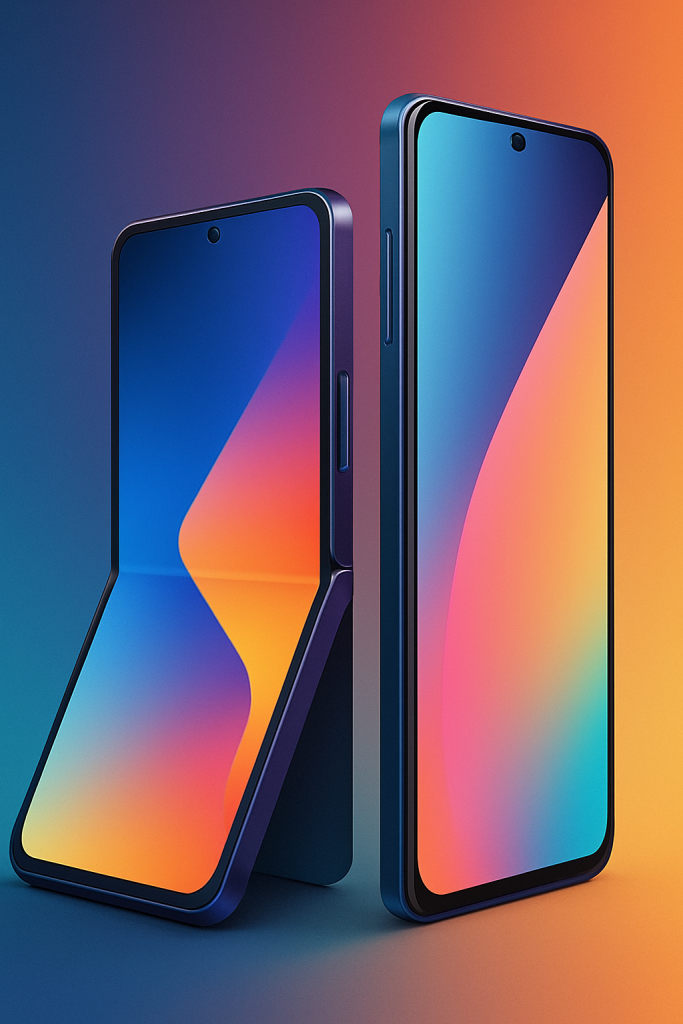
The smartphone market increasingly caters to niche preferences, and Samsung’s 2025 lineup proves it with two distinctive compact devices. On one hand you have the Galaxy Z Flip 7, a pocket‑friendly foldable that channels nostalgia with its clamshell design while embracing modern tech. On the other hand there’s the Galaxy S25 Edge, the thinnest and lightest flagship Samsung has ever made. Both phones prioritise portability, yet they achieve it in very different ways. This 500‑word comparison explores the advantages and disadvantages of each device, examining design, usability, performance and value to help you decide which compact phone best suits your lifestyle.
Design and Form Factor
The Z Flip 7 retains the iconic clamshell format. When closed, it fits comfortably in a palm or pocket, making it perfect for those who value portability. The FlexWindow outer display has grown to 4.1 inches and now supports a 120‑Hz refresh rate, allowing you to view notifications, control music or reply to messages without unfolding the device. Open the phone and you’re greeted by a tall 6.7‑inch 21:9 display that remains crease‑free thanks to Samsung’s improved hinge and ultra‑thin glass technology. The device comes in playful colours and exudes a fashion‑forward vibe.
The S25 Edge, by contrast, is a classic bar phone stripped to its essentials. At just under 6 mm thick and weighing 163 g, it is remarkably slim and light. The frame is crafted from aluminium, while the front and back are protected by Gorilla Glass Armor. The 6.6‑inch 120‑Hz display curves gently at the edges, giving the phone its name. Its minimalist design appeals to users who prefer simplicity over gimmicks, but the slimness comes at a cost: the battery and camera modules are less capable than those in bulkier phones.
Performance and Battery
Both devices share the Snapdragon 8 Elite for Galaxy processor, ensuring flagship‑level performance. Day‑to‑day tasks, gaming and multitasking are handled effortlessly. The Z Flip 7 features 8 GB of RAM and up to 512 GB of storage, while the S25 Edge offers 12 GB of RAM with similar storage options. The extra RAM in the Edge may benefit heavy multitaskers, although real‑world differences are minor.
Battery life is where these phones diverge. The Z Flip 7 houses a 3,700 mAh battery split across two halves. Samsung has improved battery optimisation, but you should still expect moderate endurance—around five hours of screen‑on time under mixed use. The phone supports 25‑W wired and 15‑W wireless charging. The S25 Edge, due to its ultra‑slim frame, packs a modest 3,900 mAh battery. It supports 45‑W wired charging but lacks wireless charging. Heavy users may need to top up both devices during the day, but the Edge’s slightly larger battery gives it a small advantage.
Cameras
Neither phone targets photography enthusiasts, yet they offer capable camera systems. The Z Flip 7 features a dual‑camera setup on the back: a 50‑MP main sensor and a 12‑MP ultra‑wide lens. Thanks to software enhancements and Samsung’s Pro Visual Engine, the phone produces vibrant photos with good dynamic range. The fun part is using the camera in Flex mode—half‑open the device, place it on a surface and shoot hands‑free selfies or group photos. The inner display houses a 10‑MP selfie camera.
The S25 Edge uses a 50‑MP main camera and a 12‑MP ultra‑wide lens. The absence of a telephoto lens means you won’t get optical zoom, but the camera quality remains respectable. The smaller battery and thin frame limit image stabilisation hardware, so low‑light performance is more reliant on software. For casual photography, both devices suffice, but serious shutterbugs should look elsewhere or choose the S25 Ultra.
Verdict
Choose the Galaxy Z Flip 7 if you value a unique, foldable design that fits easily in your pocket and enjoy the novelty of Flex mode. The outer display is genuinely useful, and the phone’s style points are unmatched. Pick the S25 Edge if you want the thinnest, lightest Samsung flagship with a sleek aesthetic and slightly better battery life. Just be aware of the compromises in camera quality and battery capacity. Ultimately, your choice comes down to whether you prioritise portability through folding or slimness.


 SIMCEL ONLINE
Leave a Reply