
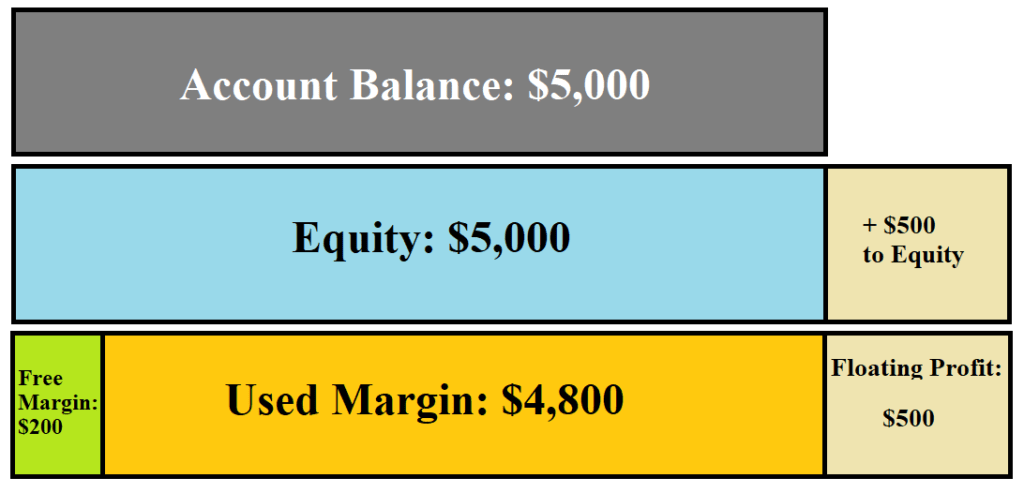
Margin trading is a popular strategy in the financial markets that allows traders to leverage their positions and gain exposure to larger trade sizes than their account balance would permit. This approach can lead to amplified profits but also carries higher risk.
In this blog post, we will provide an example of a margin trade to illustrate how this concept works and how it impacts potential gains and losses.
Example of a Margin Trade:
Let’s consider a hypothetical scenario where Jane, an experienced forex trader, has a trading account with a balance of $10,000. She believes that the EUR/USD currency pair will rise in value based on her analysis and wishes to capitalize on this opportunity using margin trading.
- Account Balance: $10,000
- Margin Requirement: 1% (Leverage of 1:100)
- Currency Pair: EUR/USD
- Current Exchange Rate: 1.2000
- Trade Size: 1 standard lot (100,000 units)
With a 1% margin requirement, Jane is required to deposit only 1% of the trade size as collateral to enter the position. Let’s calculate the margin required for this trade:
Margin Requirement = (Trade Size * Current Price) / Leverage
Margin Requirement = (100,000 * 1.2000) / 100 = $1,200
Since Jane has $10,000 in her account, she has sufficient funds to cover the required margin and proceed with the trade.
Now, let’s explore two scenarios to understand the impact of margin trading on potential gains and losses:
Scenario 1: Profitable Trade
Suppose Jane’s prediction was accurate, and the EUR/USD exchange rate increases to 1.2100. This 100-pip gain results in a profit of:
Profit = (Number of Pips * Pip Value * Number of Lots)
Profit = (100 * $10 * 1) = $1,000
In this scenario, Jane’s initial account balance of $10,000 grows to $11,000 after the trade, representing a 10% return on investment. While this is a substantial profit, it’s important to note that her actual return on capital is higher due to leveraging. Without leverage, the profit would have been $100 ($1,000 / 100), resulting in a 1% return on investment.
Scenario 2: Loss-Making Trade
However, if the market moves against Jane, and the EUR/USD exchange rate decreases to 1.1900, she incurs a loss of:
Loss = (Number of Pips * Pip Value * Number of Lots)
Loss = (-100 * $10 * 1) = -$1,000
In this case, Jane’s account balance would decrease to $9,000, representing a 10% loss on her initial investment. Without leverage, the loss would still be $100, but the percentage loss on her capital would be just 1%.
Conclusion
The example of a margin trade provided above demonstrates the potential rewards and risks associated with leveraging in trading. While margin trading allows traders to control larger positions and potentially enhance profits, it also exposes them to higher risk and potential losses. It is essential for traders to approach margin trading with careful risk management, using stop-loss orders and position sizing to protect their capital. Understanding the dynamics of margin trading empowers traders to make informed decisions and navigate the financial markets with greater confidence.


 SIMCEL ONLINE
Leave a Reply