
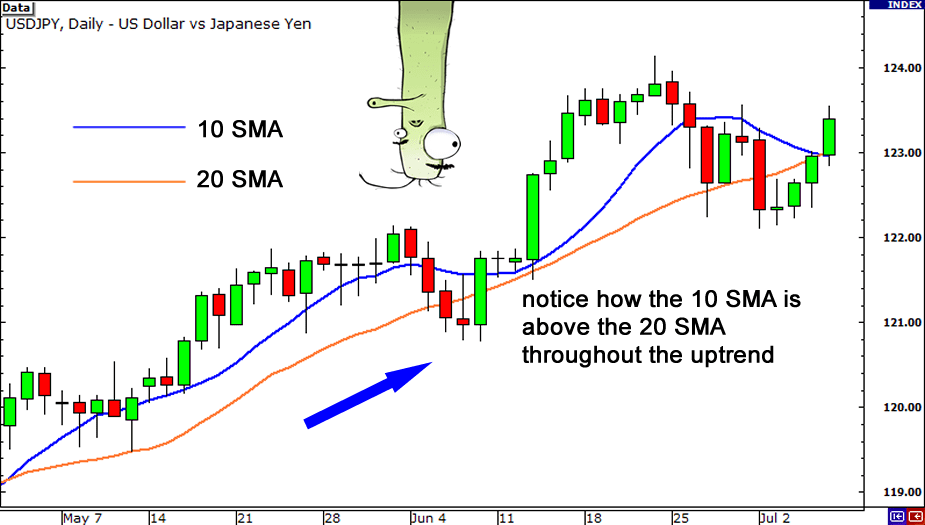
Forex trading with moving averages can be an effective way to identify trends and potential trading opportunities. Here are some tips and tricks to help you use moving averages in your forex trading:
- Use multiple timeframes: It’s important to look at multiple timeframes to get a better understanding of the overall trend. For example, if you’re looking to trade on the 4-hour chart, it’s a good idea to also look at the daily and weekly charts to see the bigger picture.
- Identify the right moving average: There are different types of moving averages, such as simple moving averages (SMA) and exponential moving averages (EMA). SMAs give equal weight to all periods, while EMAs give more weight to recent data. Experiment with both to see which works better for your trading style.
- Use different moving averages: Consider using multiple moving averages to identify trend changes. For example, you could use a shorter-term moving average, such as a 20-period EMA, and a longer-term moving average, such as a 50-period EMA. When the shorter-term MA crosses above the longer-term MA, it could signal a bullish trend, while a bearish trend could be signaled when the shorter-term MA crosses below the longer-term MA.
- Use moving averages as support and resistance levels: Moving averages can also act as dynamic support and resistance levels. For example, if the price is above the 200-period SMA, the SMA could act as a support level, while if the price is below the 200-period SMA, it could act as a resistance level.
- Avoid trading during consolidations: Moving averages may not be as effective during consolidations, as prices tend to trade in a range during such times. Look for breakouts or wait for the price to move outside the range before entering a trade.
- Use moving averages in conjunction with other indicators: Moving averages can be used in conjunction with other indicators, such as the Relative Strength Index (RSI) or the Moving Average Convergence Divergence (MACD), to confirm trading signals.
Remember, moving averages are just one tool in your trading toolbox. It’s important to use them in conjunction with other technical and fundamental analysis techniques to make informed trading decisions.


 SIMCEL ONLINE
Leave a Reply